


Industrial Oven Manufacturer — these three words carry enormous weight when you are standing in front of a production line that depends on consistent heat, precise temperature control, and zero-downtime reliability. I have personally walked through dozens of manufacturing plants across Pune and across India — from automotive pressing shops in Chakan to aerospace composite curing units in Hyderabad — and the one thing that separates a thriving production floor from a struggling one is almost always the quality of the industrial heating equipment at its core.
This is not a theoretical article. What I am sharing here comes from decades of real-world experience in designing, manufacturing, testing, and commissioning industrial ovens and furnaces. If you are a procurement engineer, plant manager, or business owner trying to make the right decision about your next heating system, you have landed at the right place.
But before we dive deep, let me tell you — choosing the wrong industrial oven manufacturer is not just a financial mistake. It is a production disaster waiting to happen. Let us make sure you get it right.
What Is an Industrial Oven? (And Why It Matters More Than You Think)
An industrial oven is a large-scale heating chamber engineered to perform controlled thermal processing on materials, components, or products. Unlike domestic ovens, industrial ovens operate at far higher temperatures — typically ranging from 50°C to 1200°C — and are designed for continuous, repeatable, heavy-duty use.
H3: Core Functions of an Industrial Oven
The primary functions that an industrial oven manufacturer designs around include:
- Drying — Removing moisture from coatings, materials, or finished components
- Curing — Cross-linking polymers, resins, and powder coatings under heat
- Baking — Processing flux, food, or composite materials to exact temperatures
- Annealing & Heat Treatment — Relieving stress and altering metallic microstructure
- Preheating — Bringing components to working temperature before further processes
- Sterilisation — Eliminating pathogens in pharmaceutical or food-grade applications
Now that we understand what an industrial oven does, let me take you to the heart of this industry — the city that builds them best.
Why Pune Is India’s Hub for Industrial Oven Manufacturers
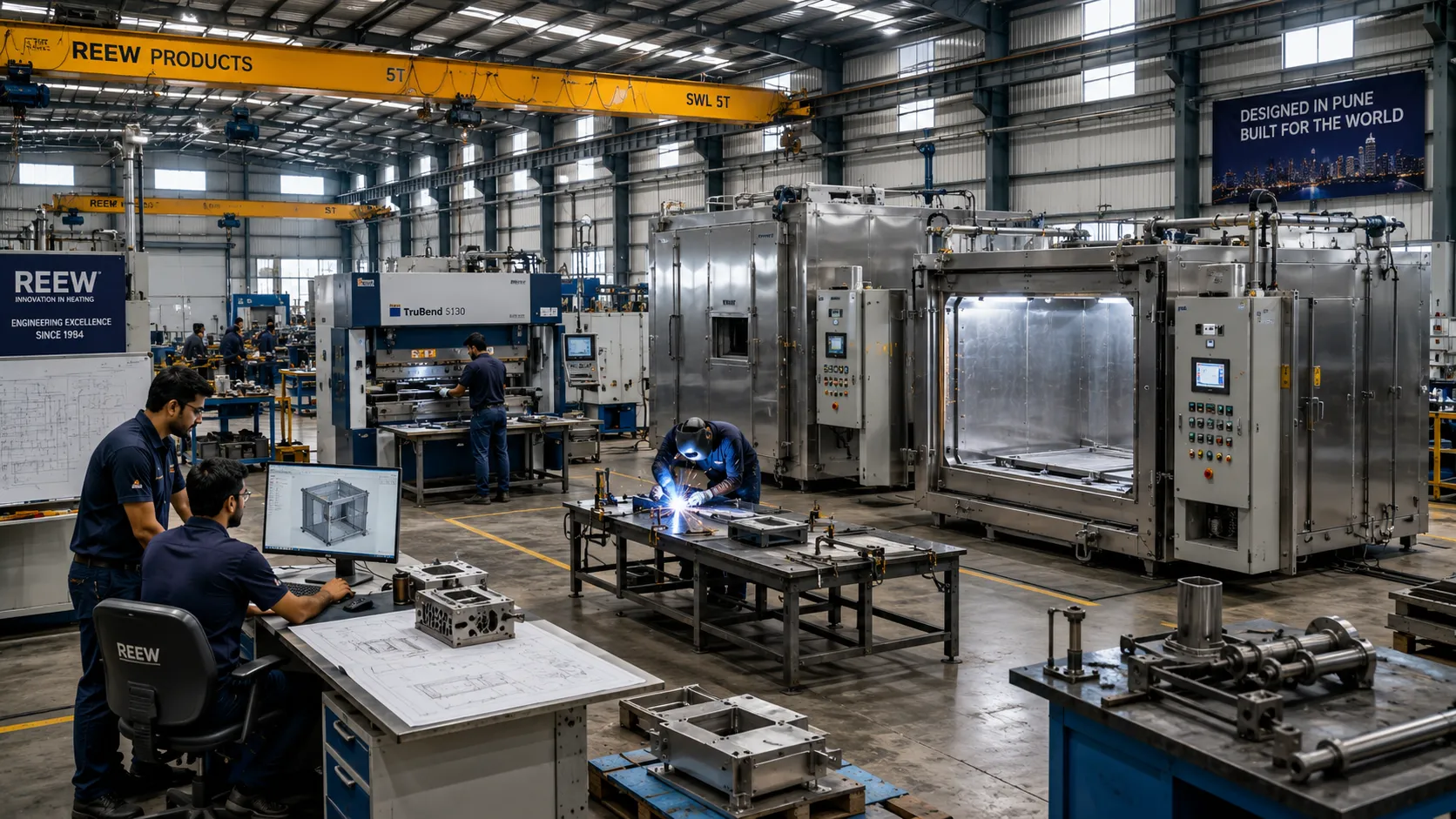
Pune is not just Maharashtra’s industrial capital — it is one of Asia’s most dynamic engineering and manufacturing cities. When clients from Delhi, Bangalore, Chennai, or even international buyers look for a reliable industrial oven manufacturer in India, a significant portion of their search leads them here — and for very good reason.
What Makes Pune Stand Out?
- Engineering Ecosystem: Pune hosts thousands of precision engineering companies, giving oven manufacturers access to world-class raw materials, fabrication partners, and component suppliers.
- Automotive Legacy: Being home to brands like Tata, Bajaj, Mercedes-Benz India, and Volkswagen India means industrial oven manufacturers in Pune constantly innovate to meet automotive-grade standards.
- Skilled Workforce: Pune’s engineering colleges and ITIs supply a steady stream of trained technicians who understand industrial heating processes.
- Logistics Advantage: PAN-India logistics from Pune is seamless via NH-48, the Mumbai-Pune Expressway, and Pune International Airport for export shipments.
I remember the first time I stood inside a 6-metre-long trolley oven being assembled in a Pune factory. The precision of the insulation, the placement of heating elements, the PID controller calibration — it was devotion to engineering, not just manufacturing. That experience is what builds your trust in a Pune-made product.
Types of Industrial Ovens and Their Applications
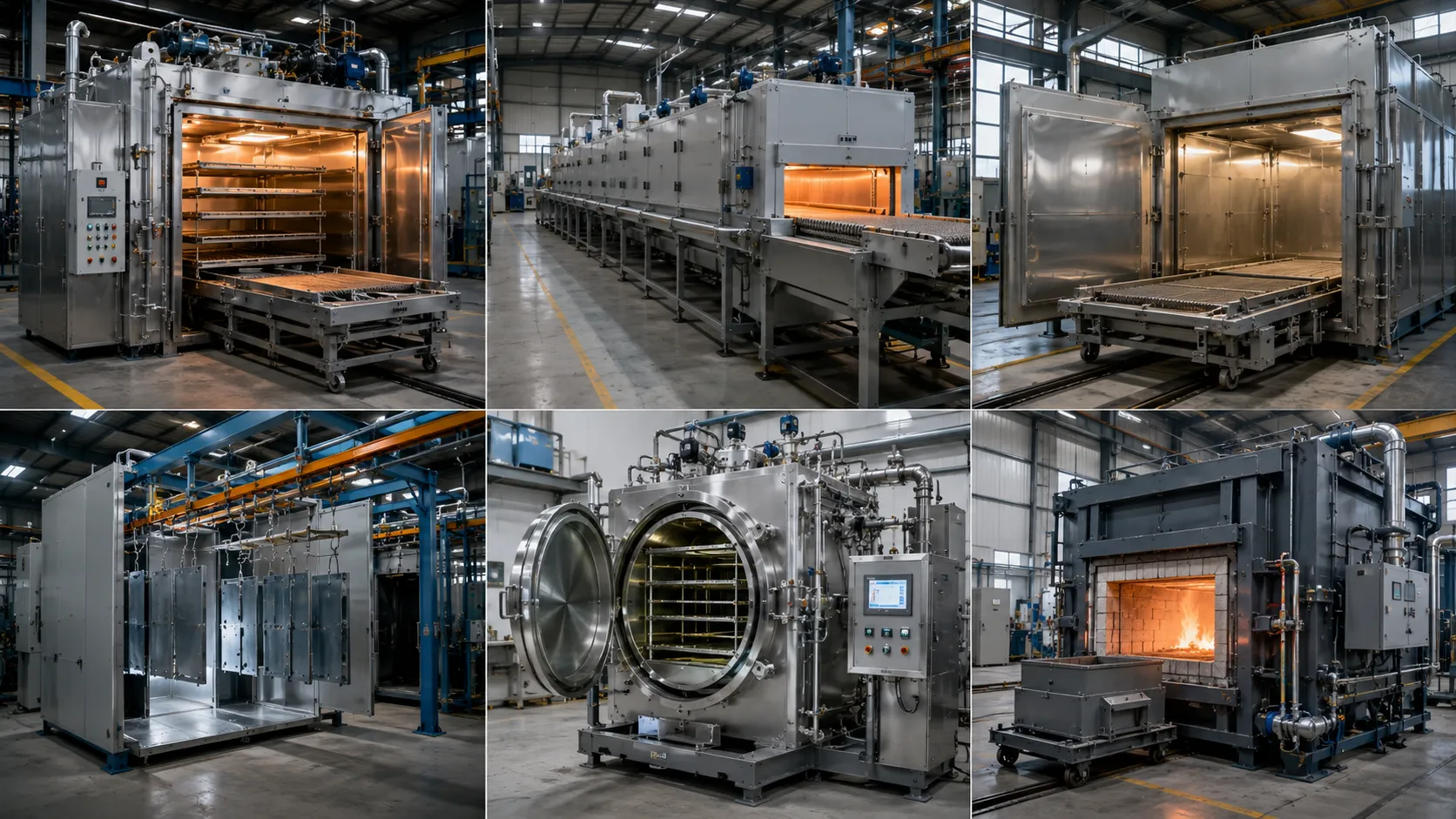
This is where most buyers get confused. There is no “one-size-fits-all” industrial oven. Every process demands a different design. Here is a comprehensive overview:
Batch Ovens (Cabinet Ovens)
Batch ovens are the most common type offered by any industrial oven manufacturer in Pune. Products are loaded, the door is closed, and the entire batch is processed at once.
Best For: Heat treatment, drying, curing, laboratory testing Temperature Range: 50°C – 650°C
2. Continuous / Conveyor Ovens
Products move through the oven on a conveyor belt for non-stop, high-volume production.
Best For: Automotive coating lines, wire annealing, food processing Temperature Range: 100°C – 400°C
3. Trolley Type Ovens (Truck Ovens)
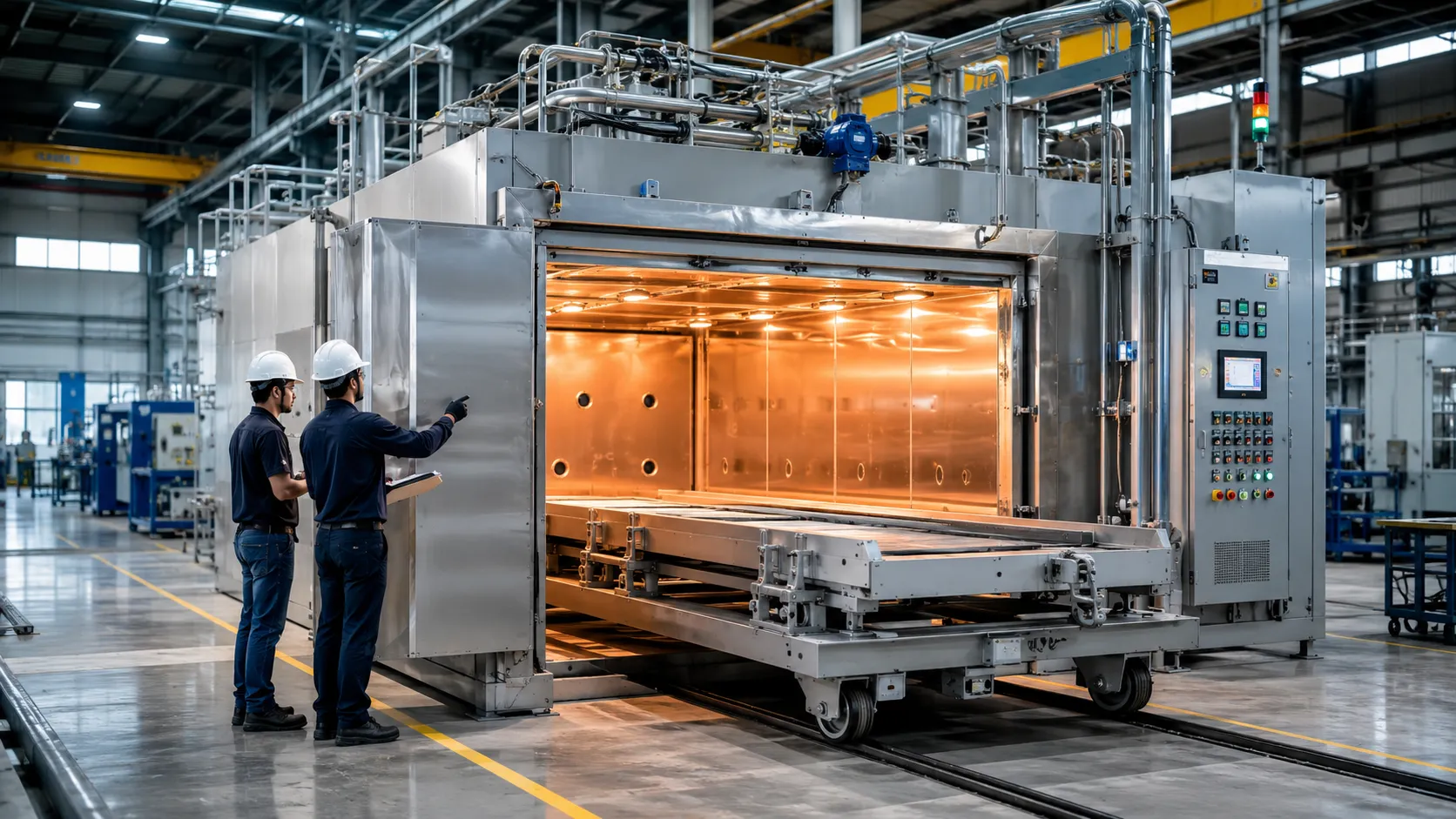
Large products are loaded onto trolleys/trucks and rolled into the oven chamber. Extremely popular with automotive, aerospace, and heavy fabrication industries.
Best For: Large castings, transformer coils, composite panels Temperature Range: 100°C – 800°C
4. Powder Coating Ovens
Designed to cure electrostatically applied powder coatings on metal surfaces. Energy efficiency and uniform airflow are critical.
Best For: Metal furniture, automotive parts, electrical enclosures Temperature Range: 180°C – 220°C
5. Flux Baking Ovens
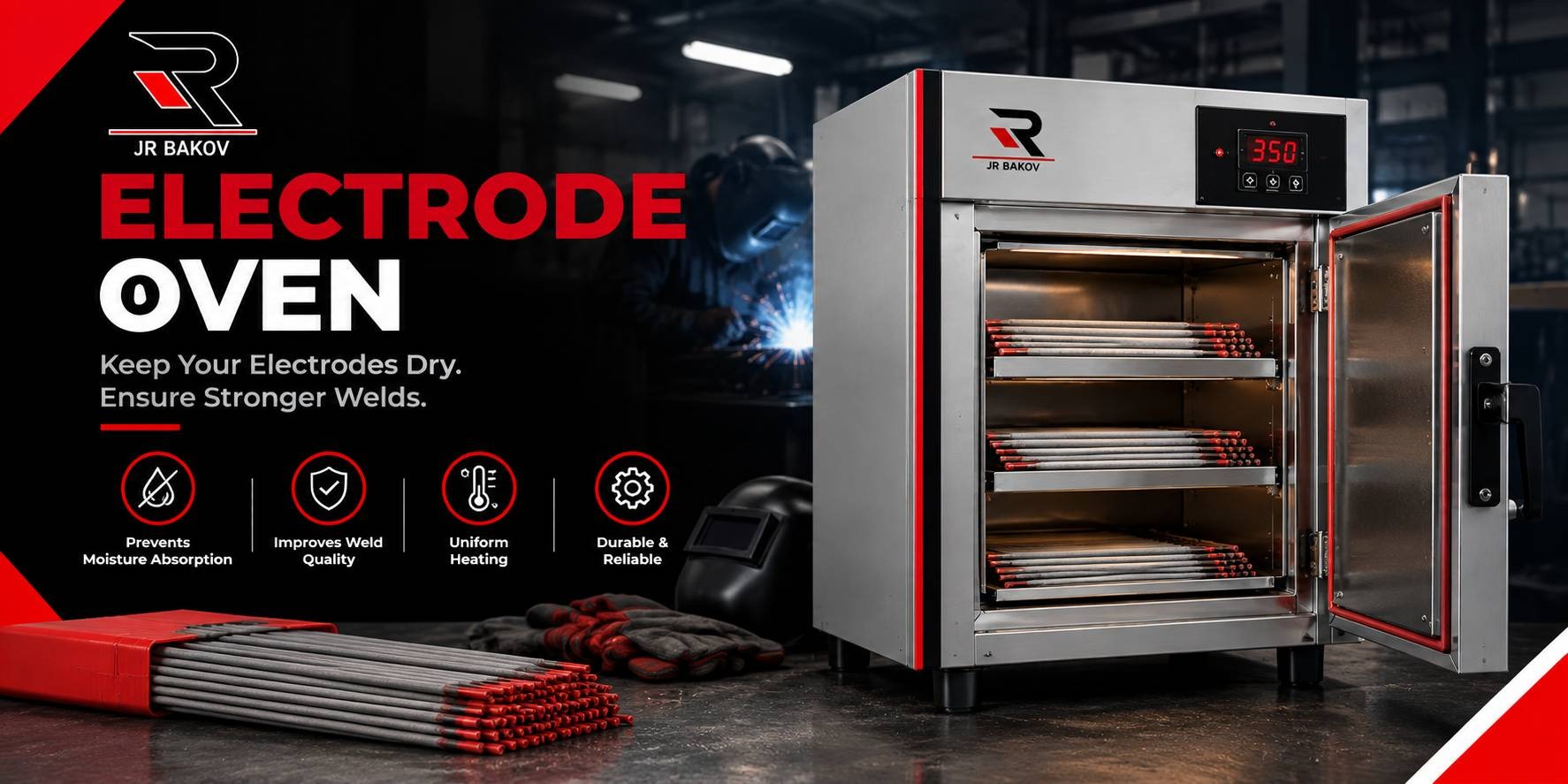
Specialised ovens designed to remove moisture from welding flux before submerged arc welding. Critical for weld quality and structural integrity.
Best For: Shipbuilding, pressure vessels, pipeline manufacturing Temperature Range: 100°C – 350°C
Read our in-depth guide: Complete Guide to Flux Baking Ovens — Types, Temperature Settings & Why Pune Manufacturers
6. Laboratory Vacuum Ovens
Precision vacuum ovens remove oxygen from the heating environment, preventing oxidation. Used in research labs, pharmaceuticals, and electronics.
Best For: Semiconductor testing, pharmaceutical drying, materials research Temperature Range: 50°C – 300°C (under vacuum)
7. Fiberglass Curing Ovens
Engineered for composite curing processes where fibre-reinforced polymers must be heated under controlled conditions without hot spots or temperature deviation.
Best For: Aerospace composites, wind turbine blades, marine panels Temperature Range: 80°C – 250°C
8. Industrial Furnaces
While ovens process temperatures up to ~750°C, industrial furnaces go beyond — into the 1000°C–1600°C range — for metal hardening, sintering, and annealing.
Learn more: Heat Treatment Furnace Manufacturer in India — REEW Blog
Industrial Oven Types at a Glance — Quick Reference Table
| Oven Type | Primary Application | Typical Temperature | Industries Served |
|---|---|---|---|
| Batch / Cabinet Oven | Drying, Curing, Testing | 50°C – 650°C | General Manufacturing |
| Conveyor Oven | High-volume coating | 100°C – 400°C | Automotive, Wire |
| Trolley Type Oven | Large components | 100°C – 800°C | Aerospace, Defence |
| Powder Coating Oven | Surface coating cure | 180°C – 220°C | Metal Fabrication |
| Flux Baking Oven | Welding flux drying | 100°C – 350°C | Shipbuilding, Piping |
| Laboratory Vacuum Oven | Research & pharma | 50°C – 300°C | Pharma, Electronics |
| Fiberglass Curing Oven | Composite curing | 80°C – 250°C | Aerospace, Marine |
| Industrial Furnace | Heat treatment | 800°C – 1600°C | Foundry, Metal |
Key Features to Demand from Your Industrial Oven Manufacturer
Not every manufacturer claiming to be the “best industrial oven manufacturer in India” can deliver on that promise. Here is what you must evaluate — and I say this from hard experience:
1. Customisation Capability
Off-the-shelf ovens rarely fit complex production lines. Look for a manufacturer who designs from scratch based on your:
- Product dimensions and weight
- Required temperature uniformity (±3°C, ±5°C, ±10°C)
- Required airflow pattern (horizontal, vertical, recirculating)
- Fuel type preference (electric, gas, diesel, LPG)
2. Temperature Uniformity and PID Control
The soul of a great industrial oven is its ability to maintain uniform temperature distribution across the entire chamber. Demand test reports showing temperature mapping data. Poor uniformity = rejected batches = financial loss.
3. Energy Efficiency
Industrial ovens can consume enormous amounts of energy. A good industrial oven manufacturer in Pune will design:
- High-density mineral wool insulation (150mm–200mm)
- Variable frequency drives (VFD) on blower motors
- Staggered heating element zoning
- Heat recovery systems where applicable
4. Safety Systems
An industrial oven without proper safety systems is a liability. Essential safety features include:
- Over-temperature protection cutouts
- Flame failure detection (for gas-fired ovens)
- Door interlock systems
- Exhaust fans and fume extraction
- Emergency stop panels
5. After-Sales Service and AMC
This is the point where many manufacturers fail. Once the oven is installed, the relationship should not end. Look for:
- Availability of spare heating elements, thermocouples, and controllers
- Annual Maintenance Contracts (AMC)
- Response time commitment for breakdown calls
- Remote diagnostics capability
Choosing right the first time is far less painful than replacing a machine after two years of poor performance. Trust me — I have seen both sides of this decision.
Industries Served by Industrial Oven Manufacturers in India
The demand for industrial ovens spans virtually every sector of Indian manufacturing. Here is an industry-wise breakdown:
Industry Applications Table
| Industry | Application | Oven Type |
|---|---|---|
| Automotive | Paint drying, rubber curing, component preheating | Conveyor, Batch, Trolley |
| Aerospace | Composite curing, structural bonding | Fiberglass Curing, Autoclave |
| Pharmaceutical | Component sterilisation, drying | Vacuum Oven, Clean Room Batch |
| Electronics | PCB baking, component drying | Low-temp Batch, Vacuum |
| Shipbuilding & Defence | Flux baking, weld preheating | Flux Baking, High-temp Batch |
| Powder Coating & Painting | Coating cure | Powder Coating Oven |
| Foundry & Metal | Annealing, hardening, tempering | Industrial Furnace, Trolley |
| Electrical | Coil impregnation, winding drying | Batch, Armature Drying |
| Rubber & Plastics | Vulcanisation, moulding | High-pressure Batch |
| Food & Agro | Dehydration, baking | Food-grade Conveyor |
REEW Products — 40+ Years of Devotion to Industrial Heating
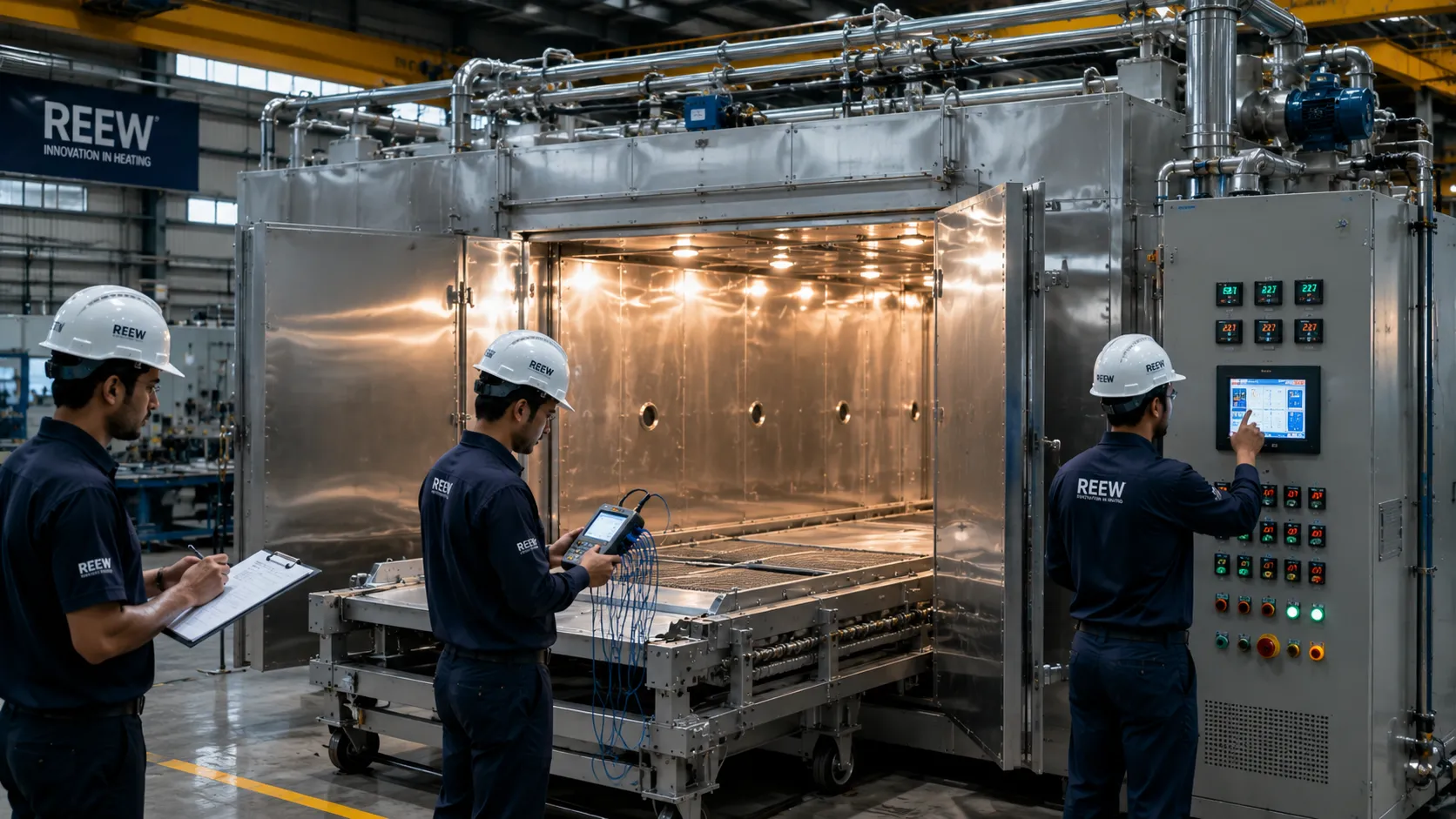
When I first visited the REEW (Rajesh Electricals and Engineering Works) facility in Pune, what struck me was not the size of the factory — it was the devotion to every weld, every insulation layer, every thermocouple placement. This is a company that has been building industrial ovens and furnaces since 1980.
H3: What Sets REEW Apart as an Industrial Oven Manufacturer?
- Since 1980: Over 40 years of continuous manufacturing experience
- Complete In-House Manufacturing: Every oven is designed, fabricated, tested, and pre-commissioned before dispatch — not assembled from bought-out shells
- Custom-Built Solutions: No two REEW ovens are identical. Every system is engineered for your specific process
- Industries Served: Automotive, Pharmaceutical, Aerospace, Electrical, Industrial Manufacturing
- Product Range: Hot Air Blowers, Fiberglass Heating Ovens, Trolley Type Ovens, Furnace Heating Elements, Laboratory Vacuum Ovens, Control Panels, Flux Baking Ovens, Powder Coating Ovens, Multi-Chamber Ovens
H3: REEW Product Portfolio at a Glance
| Product | Key Feature | Application |
|---|---|---|
| Industrial Hot Air Blower | Uniform hot air circulation | Drying, preheating |
| Fiberglass Heating Oven | Anti-corrosion chamber | Composite, chemical |
| Trolley Type Oven | Large chamber, roll-in loading | Heavy components |
| Furnace Heating Element | High-temp resistance alloys | Furnace retrofitting |
| Laboratory Vacuum Oven | Precise vacuum control | R&D, pharma |
| Control Panels | PID, SCADA integration | All oven types |
| Flux Baking Oven | Moisture-proof construction | Welding, fabrication |
| Powder Coating Oven | Uniform airflow design | Surface finishing |
Industrial Oven vs Industrial Furnace — Know the Difference
This question comes up constantly, and getting it wrong can cost you significantly:
| Parameter | Industrial Oven | Industrial Furnace |
|---|---|---|
| Temperature Range | Up to ~750°C | 750°C – 1600°C+ |
| Primary Use | Drying, Curing, Baking, Coating | Hardening, Sintering, Melting |
| Construction | Sheet metal + insulation | Refractory brickwork / castable |
| Atmosphere | Air / inert gas | Air, nitrogen, vacuum, endothermic |
| Industries | All general manufacturing | Foundry, forge, metal treatment |
| Cost | Lower | Higher |
Deep dive: Heat Treatment Furnace Manufacturer in India
How to Calculate the Right Industrial Oven Size for Your Factory
Many buyers make the costly mistake of undersizing or oversizing their oven. Here is a simple framework:
H3: Step-by-Step Sizing Guide
Step 1 — Define your largest product dimensions Add 150mm–200mm clearance on all sides for airflow.
Step 2 — Calculate batch weight Multiply unit weight × units per batch. Add 20% safety factor.
Step 3 — Determine required heat-up time This defines the kW rating needed. Typical formula: kW = (mass × specific heat × ΔT) / (time in seconds × efficiency)
Step 4 — Account for thermal losses Add 25–30% for door losses, wall conduction, and product absorption.
Step 5 — Decide on temperature uniformity class
- Class A (±3°C): Aerospace, pharma
- Class B (±5°C): Automotive, composite
- Class C (±10°C): General industrial
A good industrial oven manufacturer in Pune will do all of this sizing calculation for you — free of charge — as part of the enquiry process. If they don’t, walk away.
Common Mistakes Buyers Make When Choosing an Industrial Oven Manufacturer
I have seen these mistakes cause serious problems, and I want to save you from them:
- Choosing on price alone — The cheapest oven is almost always the most expensive in the long run (poor insulation, energy waste, frequent breakdowns)
- Not specifying temperature uniformity — Without this, you cannot hold your manufacturer accountable for performance
- Ignoring after-sales service geography — A Mumbai-based manufacturer serving a Coimbatore client will have long response times for breakdowns
- Not requesting a factory acceptance test (FAT) — Always insist on seeing your oven run at temperature before it leaves the factory
- Skipping the AMC — Preventive maintenance is always cheaper than emergency repair
- Underspecifying the control system — A basic on/off thermostat cannot deliver the precision a PID-controlled oven can
Related Blog Articles from REEW
Explore these in-depth guides from the REEW blog that will further help your decision-making:
- How to Choose the Right Industrial Oven for Your Factory in Pune — A step-by-step buying guide tailored for Pune manufacturers
- Complete Guide to Flux Baking Ovens: Types, Temperature Settings & Why Pune Manufacturers — Everything about flux baking ovens from a Pune manufacturer’s perspective
- Flux Baking Oven Complete Guide — How They Work, Types, and How to Choose One — Deep technical reading on flux oven operation and selection
- Heat Treatment Furnace Manufacturer in India — If your process requires temperatures above 750°C, this is your guide
What does an industrial oven manufacturer do?
An industrial oven manufacturer designs, fabricates, tests, and commissions thermal processing equipment used in manufacturing industries. Their products include batch ovens, conveyor ovens, trolley ovens, vacuum ovens, flux baking ovens, powder coating ovens, and furnaces. They customise every oven to the client’s process requirements, product dimensions, temperature range, and production volume.
Who is the best industrial oven manufacturer in Pune?
REEW Products (Rajesh Electricals and Engineering Works), operating since 1980, is one of the most experienced and trusted industrial oven manufacturers in Pune, India. They serve automotive, aerospace, pharmaceutical, and electrical industries with custom-designed, factory-tested heating systems. Contact: https://reew.in | Phone: 08046077822
What is the price of an industrial oven in India?
Industrial oven prices in India vary significantly based on size, temperature range, type, and features. A basic batch oven starts from approximately ₹80,000–₹2,00,000, while large trolley ovens or high-temperature furnaces can range from ₹5,00,000 to ₹50,00,000 or more. Custom-engineered systems are priced on enquiry. For an accurate quote, contact a qualified industrial oven manufacturer directly.
External reference: Bureau of Energy Efficiency, India — Industrial Heat Process Guidelines — Follow BEE guidelines for energy-efficient heating system selection.
What is the difference between an industrial oven and a furnace?
An industrial oven operates at temperatures up to approximately 750°C and is primarily used for drying, curing, baking, and coating applications. A furnace operates above 750°C and is used for metal hardening, sintering, annealing, and melting processes. The construction methods, refractory materials, and control systems differ significantly between the two.
Frequently Asked Questions (FAQs)
1. What is the lead time for a custom industrial oven from a Pune manufacturer?
Lead times vary based on complexity, but most custom industrial ovens from Pune manufacturers take 4 to 12 weeks from order confirmation to delivery. Standard batch ovens may be available faster (2–4 weeks), while large trolley ovens or special-atmosphere furnaces can take 12–16 weeks.
2. Can an industrial oven manufacturer in India export products?
Yes. Several Indian manufacturers, including REEW Products in Pune, have the capacity to export industrial ovens globally. Indian-manufactured ovens meet international quality standards and are competitively priced, making them attractive for buyers in the Middle East, Southeast Asia, and Africa.
3. What certifications should an industrial oven manufacturer hold?
Look for manufacturers holding ISO 9001:2015 certification for quality management systems. For specific industries, CE marking (for European clients), ATEX certification (for explosive atmospheres), and compliance with BIS standards may also be relevant.
4. What fuel types are available for industrial ovens in India?
Industrial ovens in India can be manufactured to run on:
- Electric resistance heating (most common, cleanest)
- LPG / Natural gas (lower running cost for large ovens)
- Diesel-fired systems (for remote locations without grid/gas supply)
- Infrared heating (for surface coating applications)
5. How important is temperature uniformity in an industrial oven?
Temperature uniformity is critical. Poor uniformity causes inconsistent curing, defective products, and material wastage. Aerospace and pharmaceutical applications typically demand ±3°C uniformity, while general manufacturing may accept ±10°C. Always ask your manufacturer for a temperature survey report.
6. What is the typical lifespan of a quality industrial oven?
A well-manufactured industrial oven, properly maintained, can last 15 to 25 years. The key factors are insulation quality, heating element grade, controller brand, and adherence to an annual maintenance contract (AMC) schedule.
7. What is a flux baking oven and who needs it?
A flux baking oven is a specialised industrial oven that removes absorbed moisture from welding flux before use in submerged arc welding (SAW). It is essential for industries such as shipbuilding, oil & gas pipeline manufacturing, pressure vessel fabrication, and defence equipment manufacturing. Using undried flux causes hydrogen embrittlement and weld porosity.
8. Does REEW Products offer after-sales service and AMC?
Yes. REEW Products offers comprehensive after-sales support including Annual Maintenance Contracts (AMC), spare part supply (heating elements, thermocouples, PID controllers), and on-site service teams. Contact: sales@rajeshele.com or call 08046077822.
Negative Sentiment Addressed — What Happens When You Choose the Wrong Manufacturer?
This is the painful truth that most manufacturers won’t tell you:
- A poorly insulated oven can consume 30–40% more electricity than a well-designed one — silently burning your operating budget every single day
- Temperature non-uniformity in a curing oven can mean entire batches of rejected parts, leading to rework costs and delivery delays
- A manufacturer with no local service presence means days or weeks of downtime when a heating element or controller fails
- Cheap control systems without proper safety interlocks have been known to cause factory fires — the financial and human cost of which is immeasurable
The positive side: When you choose the right industrial oven manufacturer in Pune — one with decades of experience, in-house manufacturing, and a committed service team — your oven becomes a silent, dependable partner in your production floor. It does its job, day after day, year after year, without drama. That is the experience I want every manufacturing business owner in India to have.
Ready to Find Your Perfect Industrial Oven?
If you have read this far, you are serious about getting the right heating solution for your facility. And you deserve a manufacturer who is equally serious about building it right.
Get a Free Custom Oven Consultation from REEW Products
✅ 40+ years of industrial oven manufacturing experience
✅ 100% in-house design, fabrication, and testing
✅ Customised solutions for any industry, any process, any temperature
✅ Trusted by 35+ major industrial clients across India
✅ Full after-sales support and AMC availability
📞 Call Us: 08046077822 📧 Email: sales@rajeshele.com 🌐 Visit: https://reew.in/contact/
👉 Request a Free Quote Now — Tell us your product, your process, and your temperature requirement. We will do the rest.
Comments (3)
Tubular Heater Manufacturers in India | REEW Pune
says July 28, 2026 at 9:41 am[…] -> Industrial Oven Manufacturer in Pune and India: Complete Buyer’s Guide […]
Mica Band Heater Manufacturer in Pune | REEW Since 1980
says July 29, 2026 at 9:22 am[…] -> Industrial Oven Manufacturer in Pune: Complete Buyer’s Guide […]
Flux Baking Oven: Working Principle, Temperature & Applications
says September 10, 2026 at 12:05 pm[…] -> Industrial Oven Manufacturer in Pune: Complete Buyer’s Guide […]