

Ask any experienced welding supervisor about their worst rework story, and there’s a fair chance damp electrodes are somewhere in it. Low-hydrogen electrodes are especially sensitive — leave them out of proper storage for even a few hours, and moisture pickup can quietly compromise every weld made with them.
That’s the entire reason an electrode oven exists. But here’s what most buying guides skip: not every electrode oven on the market is built the same way, and picking the wrong one wastes money either through overspending on capacity you’ll never use, or underspending on an oven that can’t keep up with your welding floor.
At REEW Products, we’ve been designing and manufacturing industrial heating equipment — ovens, furnaces, and holding systems — since 1980, supplying automotive, pharmaceutical, industrial, electrical, and aerospace manufacturers across India. This guide walks through exactly what to evaluate before you buy, so you’re choosing based on your actual welding operation, not a spec sheet that looks impressive.
What Is an Electrode Oven ?
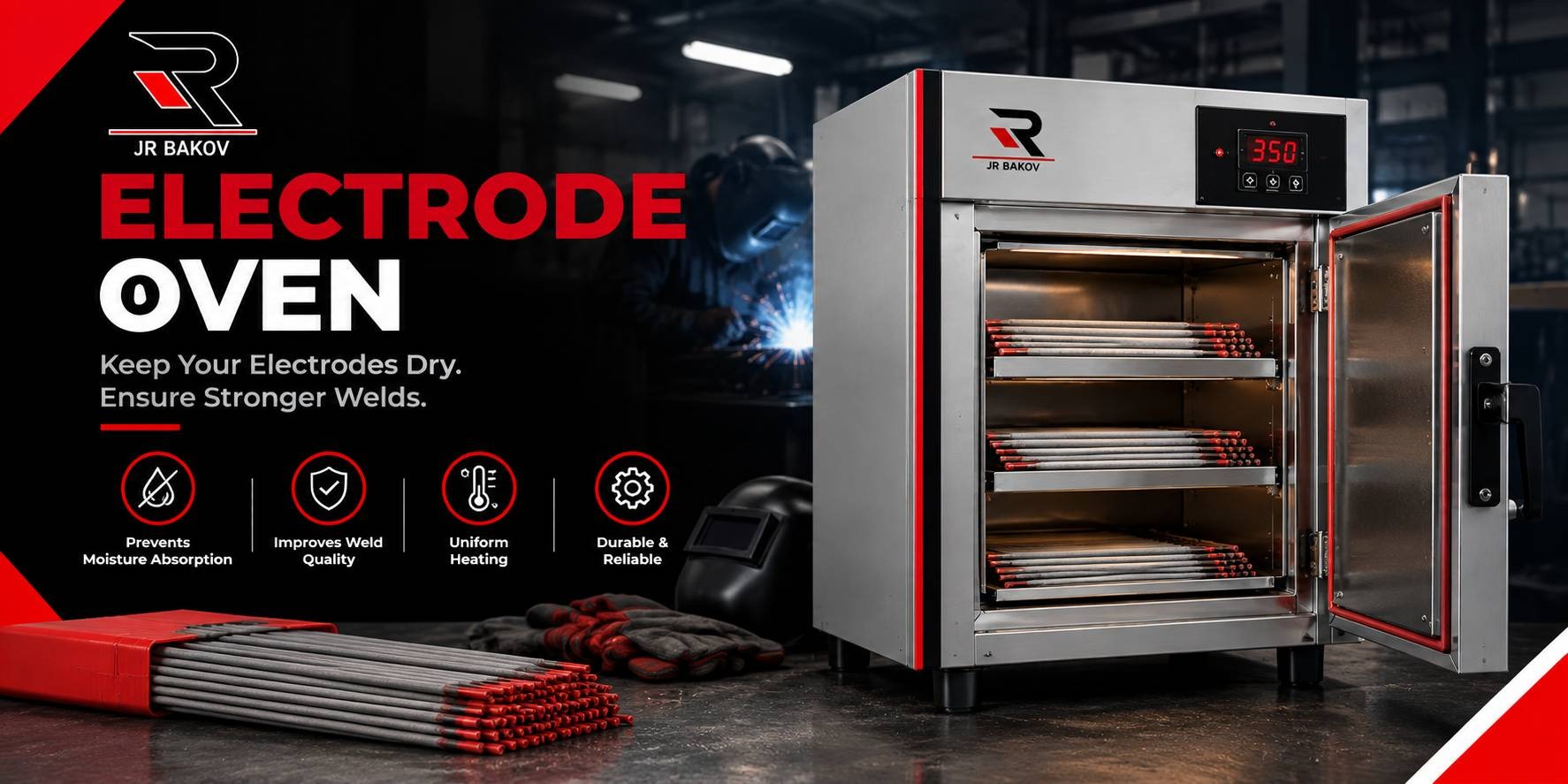
An electrode oven is an industrial heating unit used to dry, bake, or store welding electrodes at a controlled temperature, removing moisture that would otherwise cause weld defects like porosity, hydrogen cracking, or arc instability. Electrode ovens come in two main functional types — baking ovens and holding ovens — often combined into one system.
Why Electrode Moisture Control Matters So Much ?
Coated welding electrodes, especially low-hydrogen (basic-coated) types, are hygroscopic — they absorb moisture from the surrounding air almost immediately once removed from sealed packaging. Once moisture is present :
- Hydrogen is introduced into the weld pool, raising the risk of hydrogen-induced cracking
- Weld porosity increases, weakening joint strength
- Arc stability suffers, leading to inconsistent bead appearance
- Code-compliant jobs (pressure vessels, pipelines, structural steel) may fail inspection entirely
This is why electrode handling isn’t just a “best practice” in serious fabrication — it’s often a documented, code-mandated requirement (ASME, IBR, and similar standards).
Electrode Baking Oven vs. Electrode Holding Oven: Know the Difference First
| Oven Type | Purpose | Typical Temperature |
|---|---|---|
|
01
Electrode drying/baking oven
|
Actively removes moisture from new or re-exposed electrodes | 250°C – 450°C |
|
02
Electrode holding oven
|
Maintains dried electrodes at a stable low-moisture state until use | 100°C – 150°C |
|
03
Portable/rod oven (site use)
|
On-site holding for electrodes in active use at the welding station | 70°C – 150°C |
- Skipping re-baking after long storage — baked flux left in open air for days can reabsorb moisture and needs re-treatment
- Ignoring manufacturer flux data sheets — every flux brand has a specific recommended bake temperature; guessing leads to inconsistent results
- Overloading trays — packing too much flux per tray blocks airflow and causes uneven baking
- No holding oven after baking — baked flux exposed to workshop humidity between baking and use defeats the purpose entirely
- No temperature logging — for code-compliant welding (ASME/IBR jobs), you need documented proof of bake cycles, not just a working thermostat
How to Choose an Electrode Oven: The 7 Things That Actually Matter ?
1. Match Capacity to Your Actual Daily Electrode Usage
The right electrode oven capacity is based on your shift-wise electrode consumption, not the size of your welding floor. Buying oversized capacity wastes energy heating empty space; undersized capacity creates bottlenecks and forces welders to work with under-treated electrodes. Industrial electrode ovens commonly range from small 25–50 kg bench units up to 500+ kg multi-chamber systems for continuous heavy fabrication.
2. Check the Temperature Range and Control Accuracy
Different electrode grades need different bake temperatures — a basic-coated low-hydrogen electrode typically needs a much higher bake temperature than a cellulosic or rutile-coated rod. Look for:
- A PID digital controller, not a basic analogue dial
- Uniform heat distribution across every tray (not just at the sensor location)
- Data-logging capability if you’re working to a welding code that requires bake-cycle records
3. Confirm It's Built for Continuous Duty, Not Intermittent Use
Many fabrication shops run electrode ovens 8–16 hours a day, sometimes continuously. Ovens designed for light or occasional use often fail early under this kind of duty cycle. Ask your supplier directly what duty rating the heating elements and insulation are built for.
4. Decide Between Standalone Baking, Standalone Holding, or a Combined System
If you’re setting up a new welding bay, it’s usually more cost-effective to get a combined baking-and-holding electrode oven, rather than sourcing two separate units later. If you already have a holding oven and just need drying capacity, a standalone baking unit may be the smarter buy.
5. Look at Build Quality and Insulation
- Double-wall insulated bodies reduce heat loss and energy costs
- Robust hinges, door seals, and tray rails matter more than they sound — poor door seals let heat escape and pull in ambient moisture
- Corrosion-resistant internal fittings extend service life in humid or coastal locations
6. Ask About After-Sales Support, Not Just Price
An electrode oven is a long-service piece of equipment — usually 10+ years in daily use. A supplier who disappears after installation leaves you stranded when a heating element or controller eventually needs replacing. Choose a manufacturer who tests and pre-commissions the oven at their own factory before dispatch, and who offers ongoing service support.
7. Verify Customisation Options
Standard sizes don’t always fit every welding bay layout or electrode volume. A good electrode oven manufacturer should be able to build to your specific floor space, power supply, and capacity requirements rather than offering only fixed catalogue sizes.
Industrial Applications Where Electrode Ovens Are Essential
- Pressure vessel and boiler fabrication — code-mandated moisture control (ASME/IBR)
- Pipeline and structural steel welding — long continuous welds with high hydrogen-cracking risk
- Shipbuilding and heavy fabrication — high electrode turnover across large steel sections
- Automotive component manufacturing — consistent joint quality across production runs
- General fabrication and job-work shops — routine electrode handling as part of standard welding procedure.
Common Mistakes Buyers Make When Choosing an Electrode Oven
- Buying on price alone — the cheapest unit often skimps on insulation and controller accuracy, costing more in energy and rework over time
- Ignoring duty cycle rating — an oven rated for occasional use will fail fast under continuous shop-floor operation
- Skipping the holding oven — baked electrodes left exposed to workshop air between baking and use can reabsorb moisture within hours
- Not checking tray/basket capacity vs. real usage — undersized trays force multiple bake cycles, slowing down production
- No data-logging — for code-compliant jobs, you need documented proof of bake cycles, not just a working thermostat.
Why Fabricators Choose REEW as Their Electrode Oven Supplier ?
REEW Products (Rajesh Electricals and Engineering Works) has manufactured industrial heating systems since 1980, serving automotive, pharmaceutical, industrial, electrical, and aerospace clients. Every oven, furnace, and heating system we build is designed, manufactured, tested, and pre-commissioned at our own factory before it’s dispatched — so you know exactly what you’re getting before it reaches your site.
As an experienced electrode oven supplier and electrode oven manufacturer, we build standard and fully customised baking, holding, and combined electrode ovens, backed by responsive after-sales service long after installation.
Conclusion
Choosing the right electrode oven isn’t about picking the biggest unit or the lowest quote — it’s about matching capacity, temperature control, and duty cycle to your actual welding operation. Get those three things right, and you’ll spend far less time worrying about weld rejections caused by moisture-compromised electrodes.
Ready to spec out the right electrode oven for your welding floor? REEW Products designs and builds custom electrode baking, holding, and combined ovens engineered around your exact production needs. Talk to our engineering team or explore our full oven range.
FAQ SECTION
An electrode oven is used to dry, bake, or hold welding electrodes at a controlled temperature, removing moisture that would otherwise cause weld porosity, cracking, or arc instability. It's a standard requirement in code-compliant welding operations.
Baking temperature depends on the electrode coating type — basic-coated low-hydrogen electrodes commonly need 250°C–450°C, while other coatings need lower temperatures. Always check the electrode manufacturer's data sheet, since requirements vary by brand and grade.
A baking oven actively removes moisture from electrodes at high temperature, while a holding oven keeps already-dried electrodes warm at a lower, steady temperature to stop them reabsorbing moisture. Most serious welding setups need both stages.
Base capacity on your shift-wise electrode consumption, not your workshop size — industrial electrode ovens commonly range from 25 kg bench units to 500+ kg multi-chamber systems. A supplier can size the right unit once they know your daily usage.
A well-built industrial electrode oven, properly maintained, commonly serves 10+ years of daily use. Build quality — insulation, door seals, and heating element duty rating — has more impact on lifespan than price alone.
Yes — low-hydrogen electrodes exposed to workshop air for more than a few hours (depending on humidity and coating type) can reabsorb moisture and should be re-baked or transferred to a holding oven immediately after baking.