

Buying an industrial oven is not like buying standard equipment off a shelf. The wrong oven for your process can mean wasted energy, failed quality inspections, production delays, and expensive rework. Yet many factory managers in Pune and across India still make purchasing decisions based on price alone — without understanding what truly separates an oven that performs from one that merely heats.
Whether you manufacture auto components, pharmaceuticals, electrical assemblies, welding consumables, or processed food, your industrial oven is a central part of your production process. Getting the specification right from the start saves significant cost and downtime over the oven’s operating life.
This guide, written by REEW – one of Pune’s most experienced industrial oven manufacturers – walks you through every factor you need to evaluate before making your purchase decision.
What Is an Industrial Oven?
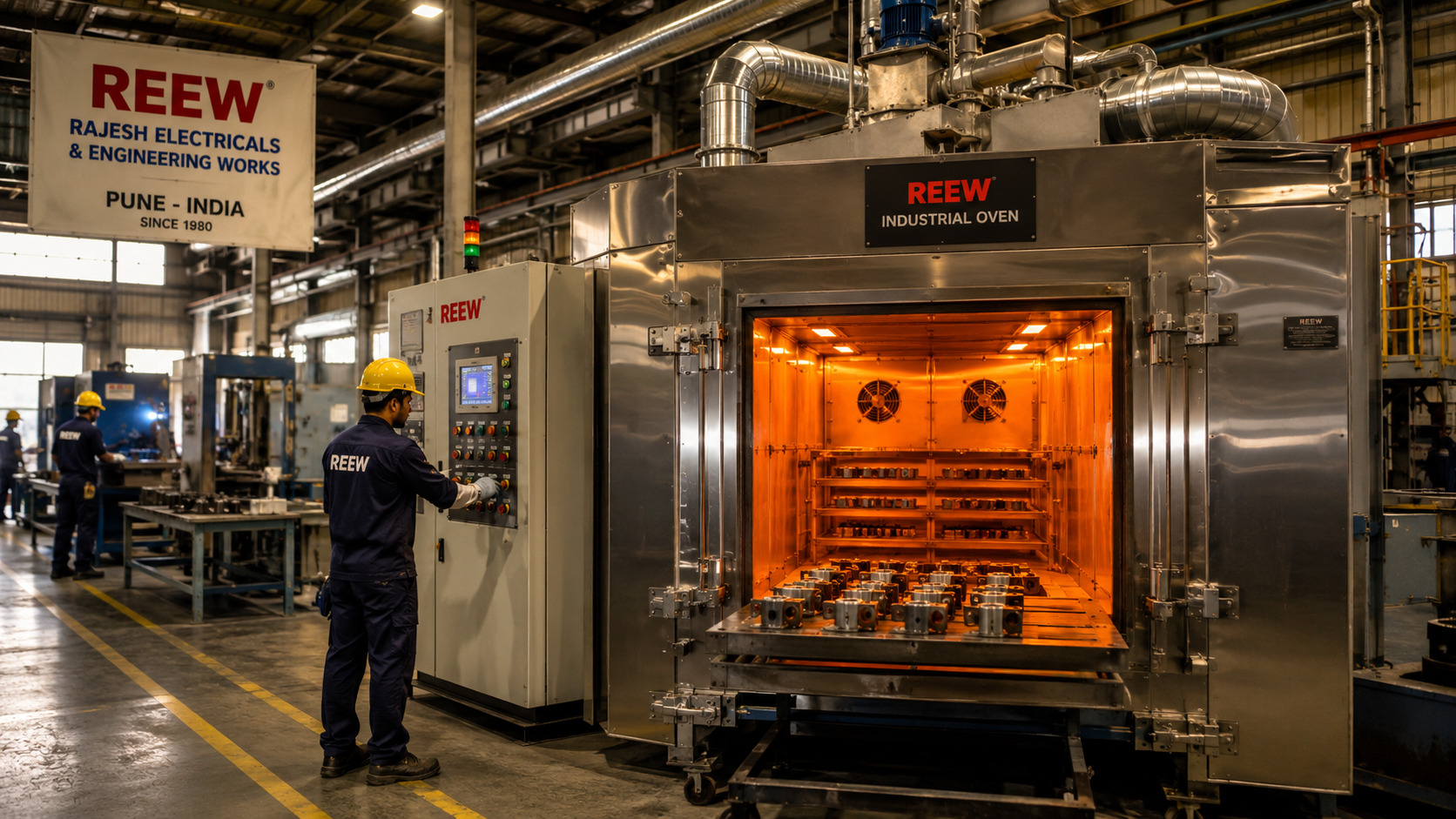
An industrial oven is a thermally insulated heating chamber used to process materials at controlled temperatures for drying, curing, baking, heat treatment, sterilisation, annealing, ageing, or other thermal processes. Unlike domestic ovens, industrial ovens are engineered for continuous, heavy-duty operation at precise temperatures with uniform heat distribution.
Industrial ovens operate across a wide temperature range – from as low as 50°C for gentle drying, up to 1200°C+ for high-temperature heat treatment and sintering processes.
They are used across virtually every manufacturing sector: automotive, aerospace, pharma, electronics, food processing, rubber, plastics, metal fabrication, welding consumables, and more.
Types of Industrial Ovens and Their Applications
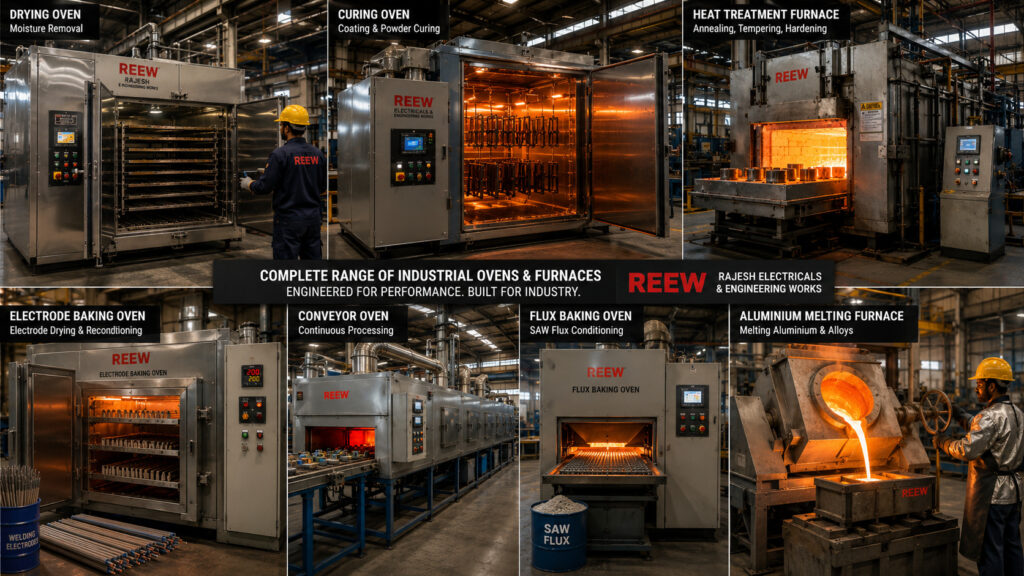
The first step in choosing the right industrial oven is understanding which type suits your process. Here is an overview of the main categories:
1. Drying Ovens
Used to remove moisture from materials, components, or products. Applications include drying painted or coated components, drying pharmaceutical granules, removing moisture from electronic assemblies, and drying welding electrodes and flux before use.
Temperature range: 50°C – 250°C. Forced air circulation ensures uniform drying across the entire load.
2. Curing Ovens
Curing ovens apply precise heat to trigger a chemical reaction – typically cross-linking of polymers in coatings, adhesives, or composites. Common in powder coating lines, rubber vulcanisation, and fibre-reinforced plastic (FRP) manufacturing.
Temperature range: 120°C – 300°C. Temperature uniformity is critical – variations beyond ±5°C can result in inconsistent curing and coating defects.
3. Heat Treatment Ovens and Furnaces
Used for annealing, normalising, stress relieving, tempering, hardening, and other metallurgical processes on metal components. Essential in the automotive, tool-making, and engineering industries.
Temperature range: 200°C – 1200°C. Atmosphere control (protective gas or vacuum) may be required for certain heat treatment processes.
4. Electrode Baking Ovens
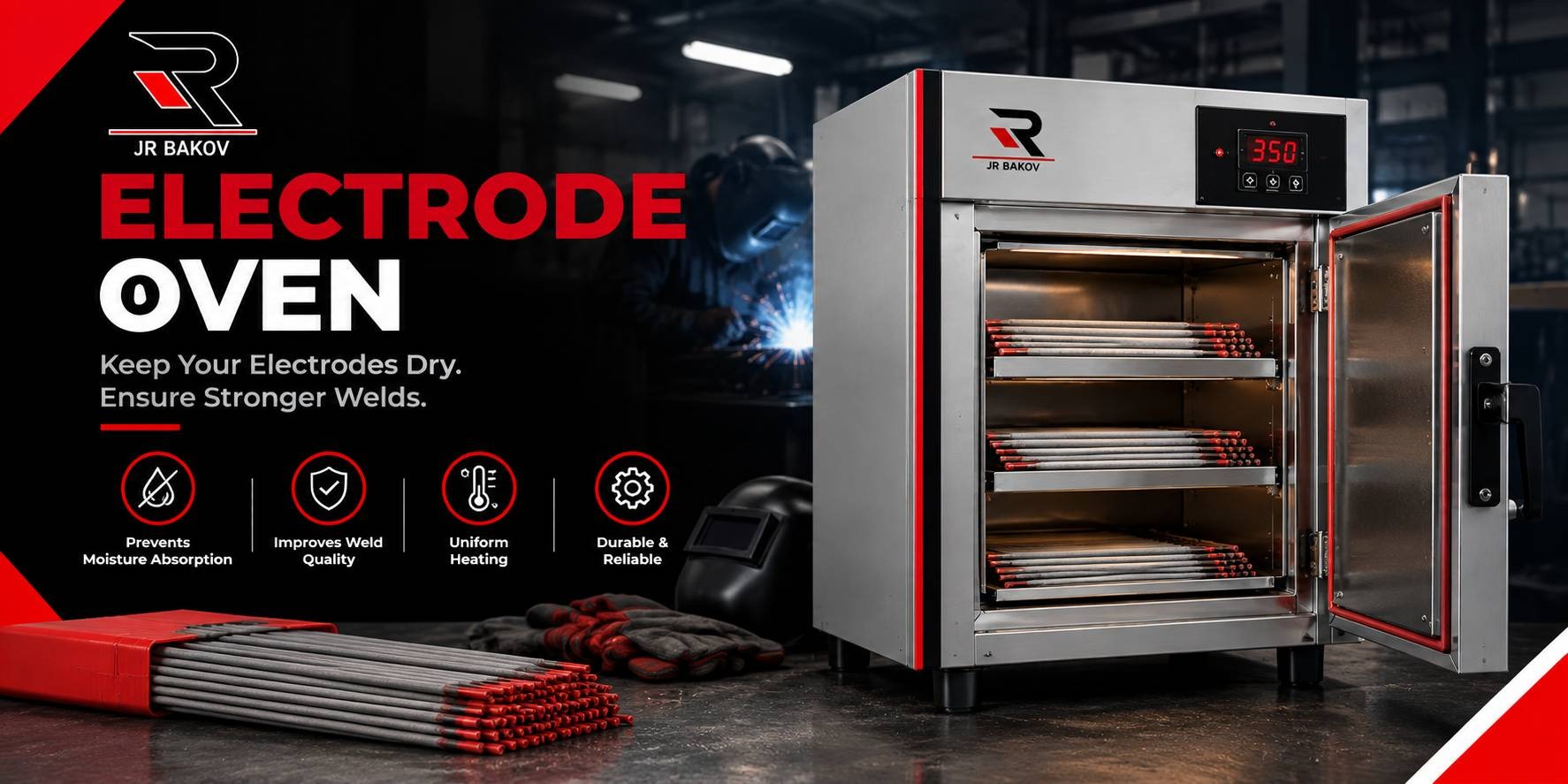
Specifically designed for drying and reconditioning coated welding electrodes (SMAW rods). Remove absorbed moisture that causes weld defects such as porosity and hydrogen cracking. Separate holding ovens maintain electrodes at temperature until needed at the welding point.
Temperature range: 100°C – 450°C. REEW is a specialist electrode oven supplier with over 40 years of experience.
5. Flux Baking Ovens
Used to condition submerged arc welding (SAW) flux before use. Available in front-loading and hopper-type (top-loading) configurations. Critical for maintaining weld quality in SAW operations.
Temperature range: 150°C – 400°C.
6. Conveyor Ovens
Continuous-process ovens where products move through on a conveyor belt. Ideal for high-volume production lines requiring consistent thermal processing of uniform products. Used extensively in automotive component curing, food processing, electronics reflow soldering, and paint lines.
Temperature range: 80°C – 350°C. Throughput and belt speed are configurable.
7. Batch Ovens
Products are loaded in batches, the oven reaches temperature, holds for the required time, then the batch is unloaded. More flexible than conveyor ovens for varied product sizes. Most industrial ovens in Pune’s fabrication and engineering sectors are batch-type.
8. Aluminium Melting Furnaces
Specialised high-temperature furnaces for melting aluminium and aluminium alloys. Used in die casting, sand casting, and foundry operations. Key performance factors are melt rate, fuel/energy efficiency, and melt quality (low dross generation).
Temperature range: 700°C – 900°C.
| Oven Type | Temp Range | Key Application | Industry |
| Drying Oven | 50–250°C | Moisture removal | Pharma, welding, electronics |
| Curing Oven | 120–300°C | Powder coating, rubber | Automotive, plastics |
| Heat Treatment | 200–1200°C | Annealing, tempering | Engineering, tools |
| Electrode Oven | 100–450°C | Electrode reconditioning | Welding |
| Flux Baking Oven | 150–400°C | SAW flux conditioning | Heavy fabrication |
| Conveyor Oven | 80–350°C | High-volume continuous lines | Auto, food, electronics |
| Aluminium Furnace | 700–900°C | Aluminium melting | Foundry, die casting |
7 Key Factors to Evaluate When Choosing an Industrial Oven
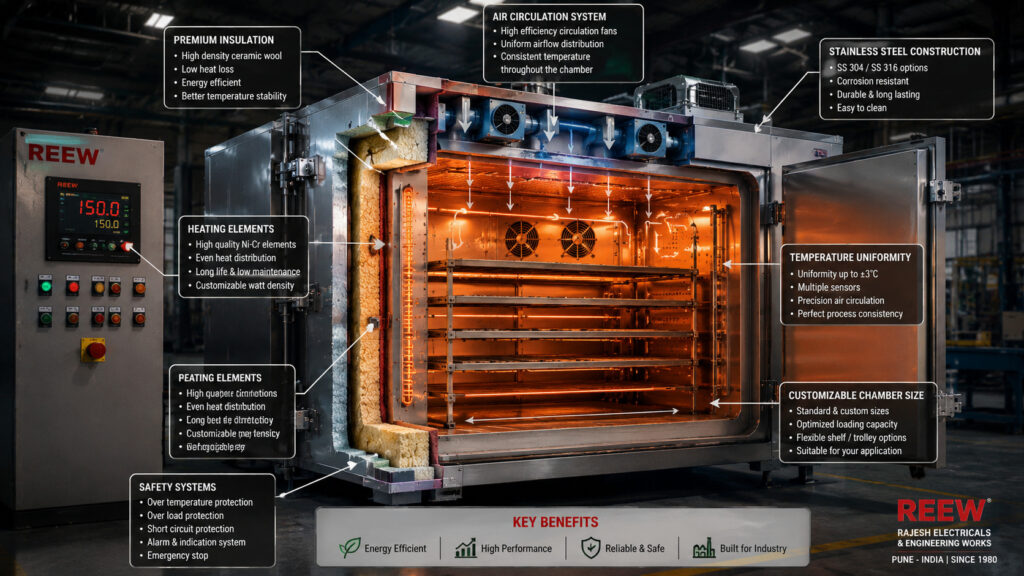
Once you know which type of oven you need, the next step is specifying the right unit. Here are the seven most important factors to evaluate:
Factor 1: Operating Temperature and Temperature Uniformity
Determine the maximum temperature your process requires and add a safety margin of 10–20%. Equally important is temperature uniformity – the variation in temperature across different points in the oven chamber when at setpoint.
For critical processes (curing, heat treatment, pharmaceutical drying), temperature uniformity within ±5°C or ±10°C is essential. Ask your supplier for test data or calibration records demonstrating uniformity across the full chamber volume.
Factor 2: Chamber Size and Load Capacity
The chamber must accommodate your largest component or maximum batch weight with adequate clearance for airflow around the load. A common mistake is buying a chamber that is barely large enough – crowding the chamber restricts airflow and creates hot and cold zones.
Rule of thumb: do not fill more than 60–70% of the chamber volume with the product load. Leave the rest for airflow circulation.
Factor 3: Heating Method
Industrial ovens are heated by electricity, gas, or diesel. Each has advantages depending on your situation:
| Heating Method | Advantages | Considerations |
| Electric | Precise control, clean, no flue required, easy to maintain | Higher running cost per unit of heat vs gas in India |
| Gas (LPG/PNG) | Lower fuel cost for high-temperature/high-volume use | Requires gas supply, flue, gas safety systems |
| Diesel | Suitable where gas unavailable, high heat output | Higher emissions, fuel storage required |
For most precision applications – electrode baking, flux conditioning, laboratory drying, pharma – electric heating is preferred for its accuracy and cleanliness. For large melting furnaces or high-temperature heat treatment, gas firing is often more economical.
Factor 4: Air Circulation and Uniformity System
Forced air circulation is essential for temperature uniformity in most industrial ovens. The fan and duct design determines how evenly heat is distributed across the chamber. Look for ovens with side or rear-ducted airflow systems rather than simple top-mounted fans.
For processes requiring very tight uniformity (aerospace parts, calibration laboratories), ask about the number of fan speeds, adjustable baffles, and independent zone control.
Factor 5: Temperature Controller
The controller is the brain of the oven. For most industrial applications, a PID (Proportional-Integral-Derivative) controller is the standard choice. It continuously adjusts power input to maintain setpoint temperature with minimal overshoot.
For more complex processes – ramp-and-soak profiles, multiple processing stages – a programmable controller with profile storage is required. Some pharma and aerospace applications require controllers with 21 CFR Part 11-compliant audit trails.
Factor 6: Insulation Quality
Insulation quality directly affects energy consumption and heat-up time. Better insulation means lower electricity bills over the oven’s operating life – often a larger cost saving than the initial price difference between oven models.
Ask about insulation material (mineral wool, ceramic fibre), insulation thickness, and the expected outer surface temperature when the oven is at maximum operating temperature. An outer surface too hot to touch (>60°C) indicates inadequate insulation.
Factor 7: Safety Features
Industrial ovens operate at high temperatures in manufacturing environments. Essential safety features include:
- Over-temperature protection (independent high-limit thermostat)
- Door interlock – oven de-energises or alarms when door opens during operation
- Proper earthing and electrical safety compliance
- Ventilation / exhaust for processes generating fumes or vapours
- Emergency stop provision
- Thermal insulation of outer surfaces to prevent burns
How to Evaluate Industrial Oven Suppliers in Pune and India
Choosing the right supplier is as important as choosing the right specification. Here is what to look for when evaluating industrial oven manufacturers in Pune or industrial oven suppliers in India:
1. Manufacturing vs Trading
Many companies in the Indian market sell industrial ovens but do not manufacture them. They buy standard units from third parties and resell without the ability to customise, modify, or support the product. Always ask: “Do you manufacture this oven at your own facility?”
REEW designs and fabricates all ovens at its Pune manufacturing facility. This means direct control over quality, customisation capability, and faster after-sales support.
2. Customisation Capability
Standard products rarely meet all process requirements. A capable manufacturer should be able to modify chamber size, temperature range, airflow configuration, controller type, door design, and electrical specification to match your exact needs.
3. Industry Experience and References
Ask for references from clients in your specific industry. A manufacturer with experience supplying ovens to the pharmaceutical sector understands GMP requirements. A supplier experienced in the welding consumables industry understands electrode baking specifications. Domain experience matters.
4. After-Sales Service and Spare Parts Availability
An industrial oven is a long-term asset – typically 10–20 years of operating life. Evaluate the supplier’s commitment to after-sales: availability of spare parts (heating elements, controllers, thermocouples, door gaskets), service response time, and calibration support.
REEW maintains stock of common spare parts and provides service support across Pune and Maharashtra.
5. Documentation and Compliance
Quality manufacturers provide: wiring diagrams, operation and maintenance manuals, calibration certificates, temperature uniformity test reports, and test certificates for electrical safety. Absence of documentation is a red flag.
Common Industrial Oven Mistakes to Avoid
| Common Mistake | Why It Costs You |
| Buying on price alone | Cheap ovens use inferior insulation and elements – higher running costs and frequent breakdowns |
| Undersizing the chamber | Overcrowding restricts airflow – non-uniform results and process failures |
| Ignoring temperature uniformity | Even a good oven can have hot/cold spots – always ask for uniformity data |
| No spare parts plan | Oven downtime with no spare elements or controller = production stoppage for days |
| Wrong heating method for process | Gas ovens for sensitive lab drying, or electric for large aluminium melting – mismatch is costly |
| No site audit before installation | Power supply inadequacy, space constraints, or ventilation issues discovered only on delivery day |
REEW: Industrial Oven Manufacturer in Pune Since 1980
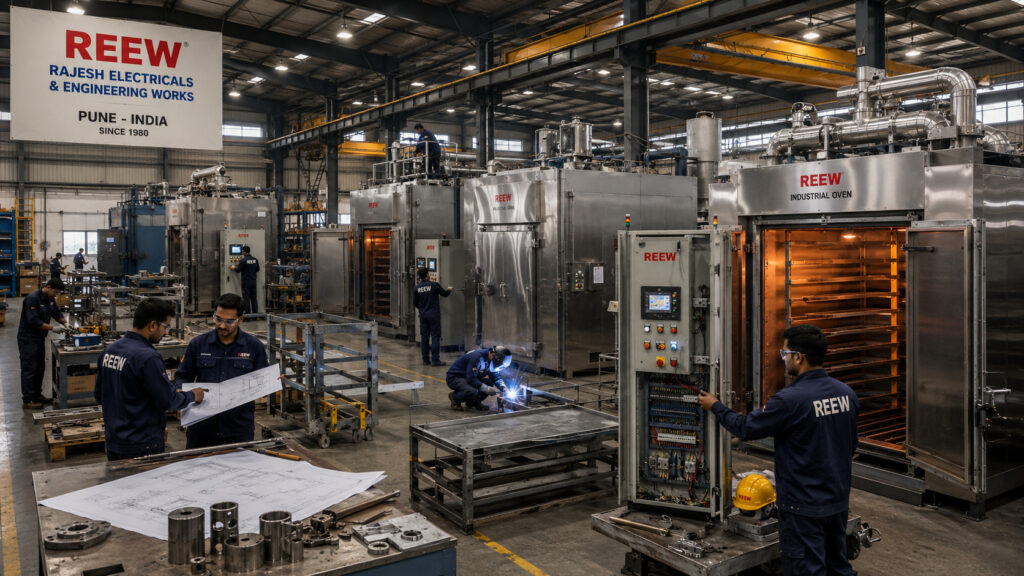
REEW (Rajesh Electricals and Engineering Works) has designed and manufactured industrial ovens, furnaces, and heating systems from Pune for over four decades. As one of the most experienced industrial oven manufacturers in Pune, REEW supplies a comprehensive range of heating equipment to clients across Maharashtra and pan-India.
REEW Industrial Oven Range
| Product | Capacity / Range | Key Feature |
| Electrode Baking Oven | 25 kg – 500 kg | PID control, SS shelves, low wattage |
| Electrode Holding Oven | 25 kg – 200 kg | Portable & stationary, 24/7 operation |
| Flux Baking Oven | 50 kg – 2000 kg | Front-load & hopper-type |
| Drying Oven | 50°C – 250°C | Forced air circulation, uniform drying |
| Curing Oven | 120°C – 300°C | Tight uniformity for powder coating |
| Heat Treatment Furnace | Up to 1200°C | Atmosphere control options |
| Conveyor Oven | Custom belt width | Variable belt speed, zoned heating |
| Aluminium Melting Furnace | 300 kg – 3000 kg | Low dross, energy efficient |
Why Manufacturers in Pune Choose REEW
- Over 40 years of design and manufacturing experience
- Full in-house manufacturing in Pune – no outsourcing
- Custom specifications on every order – no standard off-the-shelf constraints
- PID digital controllers as standard on all products
- High-density mineral wool insulation for energy efficiency
- SS 304 inner chambers for corrosion resistance
- Dedicated after-sales team in Pune and Maharashtra
- Clients in automotive, pharma, electrical, welding, and food sectors
Industrial Oven Buying Checklist
Use this checklist when evaluating any industrial oven purchase:
| ☐ | Identified the correct oven type for my process |
| ☐ | Determined maximum operating temperature required |
| ☐ | Specified required temperature uniformity (±5°C / ±10°C) |
| ☐ | Calculated chamber size needed (with 30–40% airflow allowance) |
| ☐ | Confirmed available power supply (single/three phase, amperage) |
| ☐ | Decided on heating method (electric / gas / diesel) |
| ☐ | Specified controller type (PID / programmable profile) |
| ☐ | Confirmed supplier is a manufacturer, not a trader |
| ☐ | Asked for temperature uniformity test data |
| ☐ | Confirmed spare parts availability and service support |
| ☐ | Requested documentation: wiring diagram, manual, test certificate |
Frequently Asked Questions
What is the difference between an industrial oven and an industrial furnace?
The terms are sometimes used interchangeably, but generally an industrial oven operates below 600°C and is used for drying, curing, or moderate heat treatment. An industrial furnace operates at higher temperatures (600°C – 1800°C) for processes like metal melting, sintering, and high-temperature heat treatment. REEW manufactures both.
What is the lead time for a custom industrial oven from REEW?
Standard configurations typically ship within 4–6 weeks from order confirmation. Custom-engineered units may require 8–12 weeks depending on complexity. Contact REEW’s team early in your project planning to ensure on-time delivery.
Can REEW supply industrial ovens for pharmaceutical applications (GMP)?
Yes. REEW has experience supplying drying ovens for pharmaceutical applications, with documentation including calibration certificates and temperature uniformity reports. Discuss your GMP requirements with REEW’s team during the enquiry stage.
Do REEW ovens come with a warranty?
Yes. REEW industrial ovens carry a standard warranty covering manufacturing defects. Heating elements and controllers are available as spare parts for the oven’s full operating life.
Can REEW supply industrial ovens to locations outside Pune?
Yes. REEW supplies and installs industrial ovens across Maharashtra and pan-India. Deliveries have been completed to Mumbai, Nashik, Aurangabad, Kolhapur, Chennai, and other locations.
What industries does REEW serve?
REEW supplies industrial ovens to the automotive, pharmaceutical, electrical & electronics, welding consumables, food processing, rubber & plastics, and heavy engineering sectors. Their client base includes major OEMs, Tier 1 suppliers, and government organisations.
How do I get a quote for an industrial oven?
Contact REEW with your process requirements: oven type, operating temperature, chamber size, load weight, and any special requirements. REEW will provide a detailed technical proposal and commercial quotation within 48–72 hours.
Conclusion: Making the Right Industrial Oven Decision
Choosing the right industrial oven requires a clear understanding of your process, the right specification, and a supplier who can deliver quality equipment with reliable after-sales support. Rushing this decision or buying on price alone leads to operational problems that far outweigh any initial cost saving.
REEW has helped hundreds of manufacturers across Pune and India make the right oven decision – from small 50°C drying ovens for electronics workshops to 1200°C heat treatment furnaces for the engineering sector. Their four decades of experience means you get expert guidance, not just a product.
| Get Expert Guidance on Your Industrial Oven Purchase
Contact REEW – Industrial Oven Manufacturer in Pune Phone: 08046077822 | Email: sales@rajeshele.com | Website: reew.in |
About REEW (Rajesh Electricals and Engineering Works)
REEW is a Pune-based industrial oven and heating system manufacturer with over 40 years of experience. The company designs, manufactures, and supplies electrode ovens, flux baking ovens, curing ovens, heat treatment furnaces, conveyor ovens, and industrial heating elements for clients across India.
Related Reads:
- Electrode Oven vs Electrode Drying Oven vs Electrode Holding Oven – reew.in/electrode-oven-vs-electrode-drying-oven-vs-electrode-holding-oven/
- Complete Guide to Flux Baking Ovens – reew.in/flux-baking-oven-manufacturer-pune
- Explore All Products – reew.in/products/