

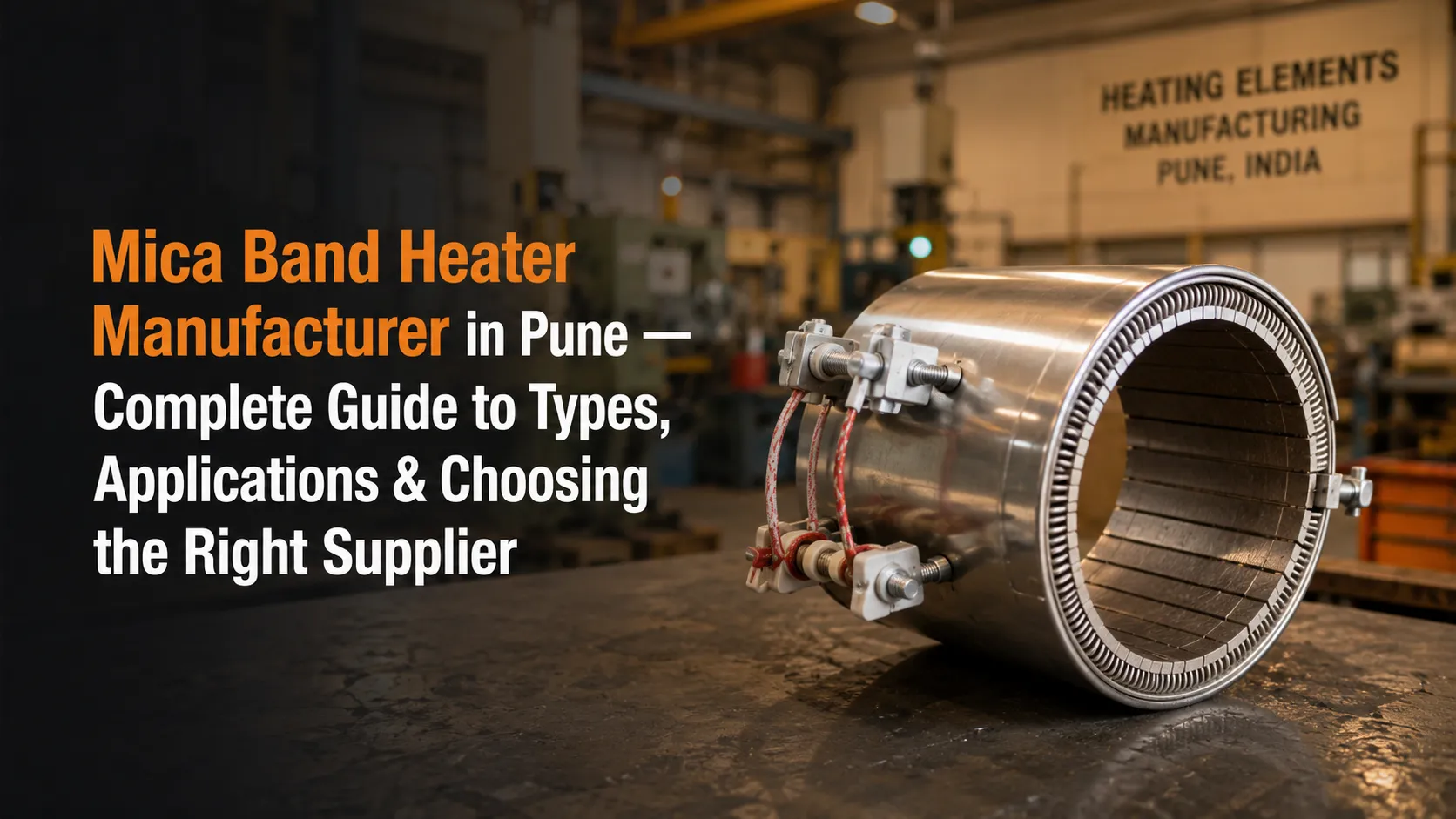
When I first started manufacturing mica band heaters at REEW in Pune over four decades ago, the plastics processing industry in India was just beginning to take off. Today, India is one of the world’s largest consumers of plastic products and the mica band heater remains the single most essential heating element that keeps every injection moulding machine, extruder, and blow moulding line in the country running. Without a quality mica band heater, your barrel does not reach temperature. Without a correctly specified one, your barrel overheats on one side and runs cold on the other and your product quality suffers every single cycle.
I have supplied mica band heaters to plastics processors, packaging manufacturers, automotive component makers, and rubber processing units across India from Pune and Aurangabad to Ahmedabad, Chennai, and Delhi. In that time, I have seen what happens when businesses prioritise price over quality in this product category: frequent failures, inconsistent processing temperatures, increased scrap rates, and the hidden cost of production downtime that dwarfs whatever was saved on the heater purchase.
This guide is my complete answer to every question a plant manager, maintenance engineer, or procurement head should ask before buying mica band heaters in Pune or anywhere in India. We will cover construction, types, applications, selection criteria, what separates quality from counterfeit, and why the right mica band heater manufacturer in India is one of the most important supplier relationships your factory can have.
What Is a Mica Band Heater? Construction, Working Principle, and Key Components
A mica band heater is a flat, semi-flexible electric resistance heater designed to clamp tightly around cylindrical or flat surfaces most commonly the barrels, nozzles, dies, and hot runners of plastic injection moulding machines, extruders, and blow moulding equipment. It transfers heat by direct conduction from its outer surface to the machine component it wraps around.
The name comes from its insulating material: muscovite mica, a naturally occurring mineral with exceptional electrical insulating properties, good thermal conductivity, and the ability to withstand temperatures up to 480 to 500 degrees Celsius. This combination of electrical safety and thermal performance makes mica the ideal insulation for heaters that must clamp tightly against electrically grounded machine barrels at high temperatures.
How a Mica Band Heater Is Constructed : Layer by Layer
- Mica core former: A sheet of high-grade muscovite mica forms the inner insulating base
- Resistance element winding: Nichrome (NiCr 80/20) resistance ribbon is precisely wound onto the mica former in even, spaced turns this is where quality makes the biggest difference
- Outer mica insulation: A second layer of mica sheet is applied over the wound resistance element to electrically insulate it from the outer sheath
- Metal sheath: A stainless steel (SS304) or mild steel (MS plated) outer shell is pressed tightly around the mica sandwich, providing mechanical protection and the clamping surface
- Clamping mechanism: Spot-welded clamp bars with Allen screws or L-type clamp brackets secure the heater tightly around the barrel
- Electrical termination: Lead wires (fibreglass insulated or PTFE insulated) or terminal boxes connect the heater to the power supply
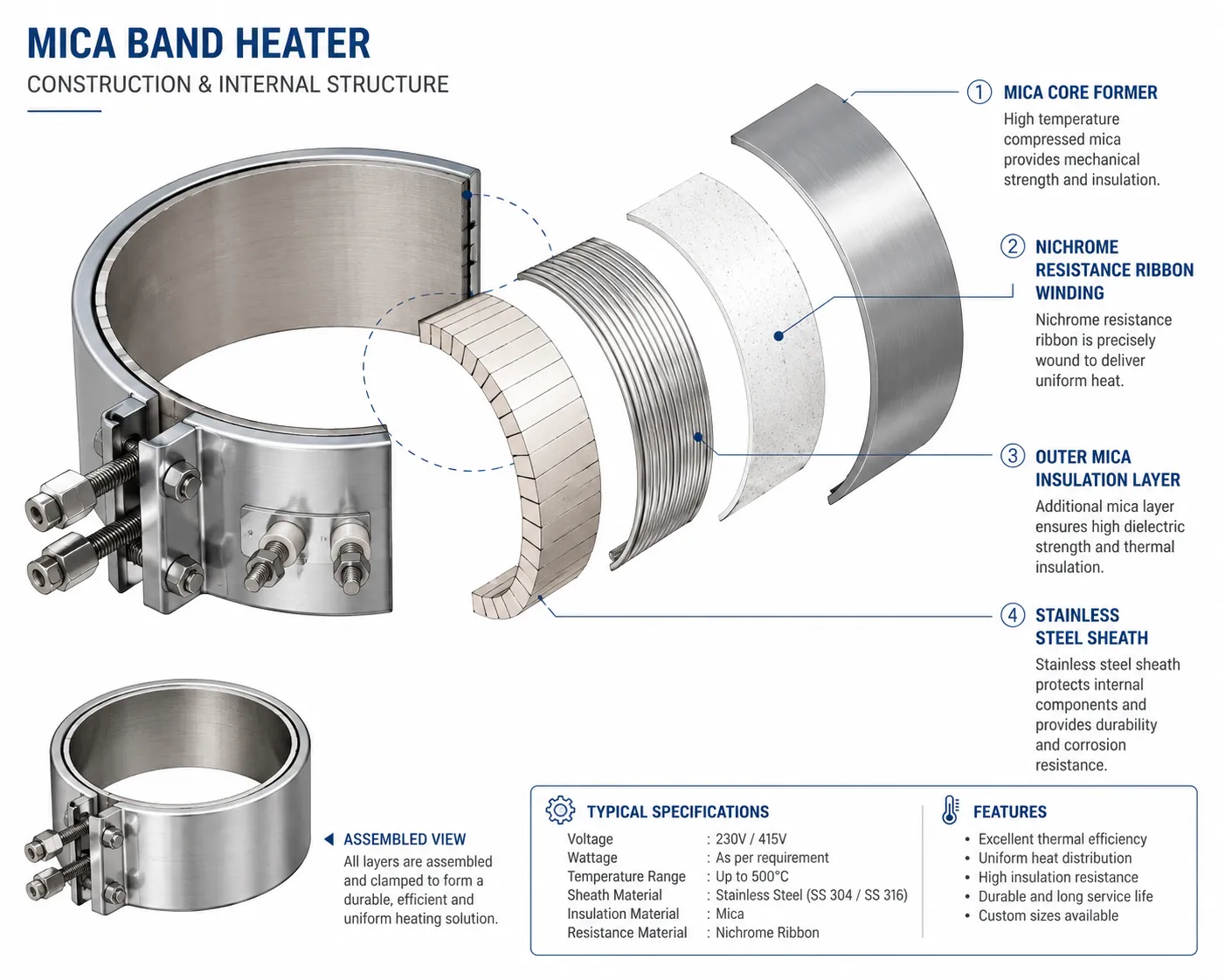
Key Construction Specifications at a Glance
| Parameter | Specification / Range | Notes |
| Insulation Material | Muscovite Mica | High temp, excellent dielectric strength |
| Resistance Element | Nichrome NiCr 80/20 ribbon | Ribbon winding for uniform heat distribution |
| Outer Sheath Material | SS304 (standard), MS plated, Brass inner | SS304 preferred for corrosion resistance |
| Max Sheath Temperature | Up to 480°C to 500°C | Mica insulation limits maximum operating temp |
| Max Watt Density | 3.0 to 3.5 W/cm2 (standard) | Higher watt density risks mica degradation |
| Voltage | 230V single phase / 415V three phase | Custom voltages available on request |
| Wattage Range | 50W to 4000W+ | Depends on barrel size and heating zone length |
| Minimum Diameter | 25 mm | Below this, ceramic band heaters preferred |
| Minimum Width | 20 mm | Narrower widths reduce clamping efficiency |
| Clamping Gap | 5 to 8 mm standard | Allows for barrel thermal expansion |
Types of Mica Band Heaters: Which One Does Your Application Need?
Not all mica band heaters are the same and choosing the wrong type for your barrel geometry or application leads to uneven heating, premature failure, or impossible installation. Here are the main types you will encounter from any reputable mica band heater manufacturer in India:
1. Standard (Single-Piece) Mica Band Heater
The most common type. A single continuous heater that wraps fully around the barrel circumference, secured by two clamping bars. Ideal for barrels where easy 360-degree access is available during installation. Fast to install, low cost, uniform heat distribution when correctly clamped.
- Applications: Injection moulding machine barrels, extruder barrels, blow moulding
- Available in: SS304 or MS outer sheath, fibreglass or PTFE lead insulation
- REEW standard mica band heaters: Minimum diameter 25 mm, width from 20 mm, custom lengths
2. Two-Piece (Split) Mica Band Heater
Constructed as two half-circle heater sections that together form a complete band around the barrel. Essential for machines where the barrel cannot be disassembled for heater installation the two halves open and close around the barrel in place. Widely used in large-diameter extruder barrel heating where single-piece installation is impractical.
- Applications: Large extruder barrels, machines in permanent installations
- Advantage: No machine disassembly required for heater replacement
- Important: The two halves must clamp together with zero gap for uniform heat transfer
3. Insulated Mica Band Heater (Energy-Saving Type)
A standard mica band heater with an additional outer layer of ceramic wool insulation, enclosed in a second stainless steel jacket. This insulation layer prevents radiated heat loss to the surrounding air which in a standard uninsulated band heater accounts for 20 to 30 percent of the total energy consumed. The result is a heater that runs at lower power consumption for the same barrel temperature.
At REEW, we recommend insulated mica band heaters to every high-production plastics processor in Pune and across India. The energy saving of 20 to 30 percent pays back the cost premium within weeks. For factories running 20 to 50 machines simultaneously, the annual electricity cost saving is substantial often exceeding Rs. 5 to 15 lakh per year.
- Energy saving: 20 to 30% reduction in heater power consumption
- Additional benefit: Cooler factory floor environment radiated heat is contained
- Temperature stability: Better maintained barrel temperature with less PID hunting
4. Mica Nozzle Heaters
Miniaturised mica band heaters specifically designed for the small-diameter nozzle zone of injection moulding machines. The nozzle is the critical point where molten plastic exits the barrel and enters the mould incorrect nozzle temperature causes drool, stringing, or cold slugs, all of which cause production defects. Nozzle heaters are typically very small in diameter (often 20 to 40 mm) and short in width.
- Sheath options: Brass inner sheath (for intimate barrel contact), SS304 outer
- Terminal options: PTFE-insulated leads preferred for nozzle zone heat resistance
- Common failure mode: Overheating from too-high watt density in the small nozzle area spec carefully
5. Mica Strip / Plate Heaters
Flat mica heaters in rectangular, square, or custom shapes used to heat flat surfaces such as hot plates, packaging machinery sealing jaws, food processing platens, and laboratory heating surfaces. The same mica-and-resistance-ribbon construction as band heaters, but formed into flat rather than curved geometry.
- Applications: Packaging heat sealing machines, food processing equipment, laboratory hot plates, dies
- Shapes: Rectangle, square, custom cut-outs for holes and mounting hardware
6. Custom-Form Mica Band Heaters
Any standard mica band heater type can be produced in custom dimensions: non-standard diameters, non-standard widths, multiple terminal positions, built-in thermocouple pockets, custom cutouts for barrel cooling holes, or special clamping systems for unusual machine geometries. REEW specialises in custom-form mica band heaters for OEM machine manufacturers and for replacement of heaters on imported European and Japanese injection moulding machines where standard Indian sizes do not fit.
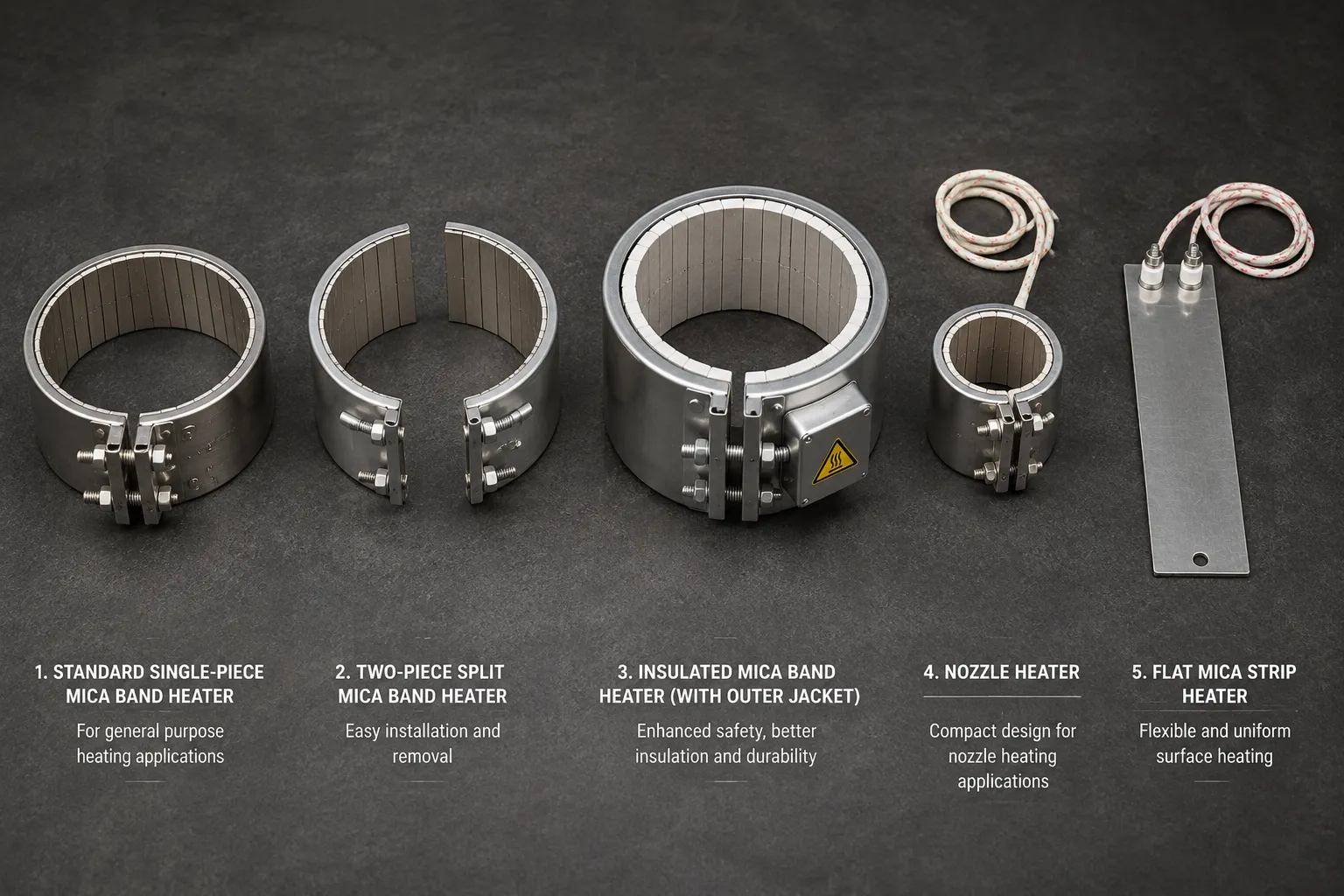
| Type | Shape | Primary Use | Key Selection Point |
| Standard Single-Piece | Full ring | Standard injection/extrusion barrels | Confirm exact barrel OD and width |
| Two-Piece Split | 2x half-ring | Large barrels, no-disassembly install | Ensure zero gap between halves when clamped |
| Insulated (Energy-Saving) | Full ring + insulation jacket | High-production lines, energy reduction | 20-30% power saving quick ROI |
| Nozzle Heater | Small ring | Injection moulding nozzle zone | Very precise watt density do not over-rate |
| Strip / Plate Heater | Flat | Sealing jaws, platens, hot plates | Match heater area to heated surface exactly |
| Custom Form | Any | OEM, imports, special geometries | Provide exact drawing or worn heater sample |
Why Mica Band Heater Quality Is Not Something You Can See But Will Always Feel
This is the most important section of this guide for any buyer. Two mica band heaters can look identical from the outside same diameter, same width, same sheath material, same terminal style and have completely different operational lives. The quality difference is entirely inside, and it comes down to three things:
1. Resistance Ribbon Winding Quality
The Nichrome resistance ribbon must be wound at perfectly even spacing across the full width of the mica former. Uneven spacing creates hot spots areas of higher heat output that exceed the mica’s thermal limit, degrade the insulation, and eventually cause the ribbon to burn through. A quality mica band heater manufacturer in Pune uses computer-aided winding design to calculate and verify the ribbon coverage before winding. A low-cost assembler winds by eye. You cannot see the difference from outside the finished heater. You will feel it in 12 months when the heater fails.
2. Mica Sheet Grade and Thickness
Industrial muscovite mica for heater applications comes in different grades and thicknesses. The correct mica grade provides the right balance between electrical insulating strength and thermal conductivity too thick and the heater runs at higher temperatures internally; too thin and the insulation can fracture under the mechanical stress of repeated thermal cycling. Grade selection and mica sourcing discipline are marks of a serious mica band heater manufacturer.
3. Clamping Pressure and Surface Contact
A mica band heater transfers heat entirely by conduction physical contact between the heater surface and the barrel surface. Any air gap in between is a thermal insulation barrier that causes the heater to overheat (because the heat cannot escape to the barrel), degrades the mica, and reduces barrel heating efficiency. Clamping bars must be strong enough to maintain consistent pressure across the full width of the heater, through thousands of thermal expansion and contraction cycles. Weak or poorly designed clamping systems allow the heater to loosen over time a failure mode that is invisible until the heater starts burning.
| Buying Advice: Always ask a potential mica band heater supplier whether they use computer-aided winding design or manual winding. Ask for their mica sheet specification grade and thickness. And ask how their clamping bars are designed and tested. These three questions will tell you immediately whether you are talking to a manufacturer or an assembler. |
| Need a Trusted Mica Band Heater Manufacturer in Pune?
REEW manufactures precision mica band heaters, ceramic band heaters, and tubular heaters from Pune, India since 1980. Every element is custom-wound, quality-tested, and backed by lifetime technical support. We supply pan-India to plastics, rubber, automotive, and packaging industries. Call: 08046077822 | Email: sales@rajeshele.com | Website: www.reew.in |
Mica Band Heater vs Ceramic Band Heater: Which One Do You Need?
The most common question I receive from plastics processors is whether to use a mica band heater or a ceramic band heater for their barrel. Both are valid choices but they serve different requirements. Here is a direct comparison:
| Parameter | Mica Band Heater | Ceramic Band Heater |
| Max Operating Temp | Up to 480 to 500°C | Up to 650°C to 700°C+ |
| Insulation Material | Muscovite mica sheets | Interlocking ceramic tiles |
| Heat Transfer | Conduction (direct contact) | Conduction (direct contact) |
| Radiated Heat Loss | Higher (unless insulated type) | Significantly lower ceramic tiles insulate outward |
| Energy Efficiency | Standard (insulated type saves 20-30%) | Higher less radiated loss as standard |
| Unit Cost | Lower more cost-effective | Higher ceramic construction is more expensive |
| Weight | Lighter | Heavier |
| Replacement Speed | Fast simple clamping | Slightly more complex tile arrangement |
| Best For | Standard temp (<480°C), cost-sensitive lines | High-temp (>480°C), energy-sensitive, precision lines |
| REEW Product | Mica band heaters from 25mm dia, custom | Ceramic band heaters for high-temp applications |
In summary: if your barrel temperature requirement is below 480 degrees Celsius and you are cost-conscious, a quality mica band heater is the right choice. If you are processing engineering polymers at temperatures above 480 degrees Celsius, or if energy cost reduction is a priority, a ceramic band heater is the better investment. REEW manufactures both and can advise on the right choice for your specific machine and polymer.
Industrial Applications of Mica Band Heaters in India
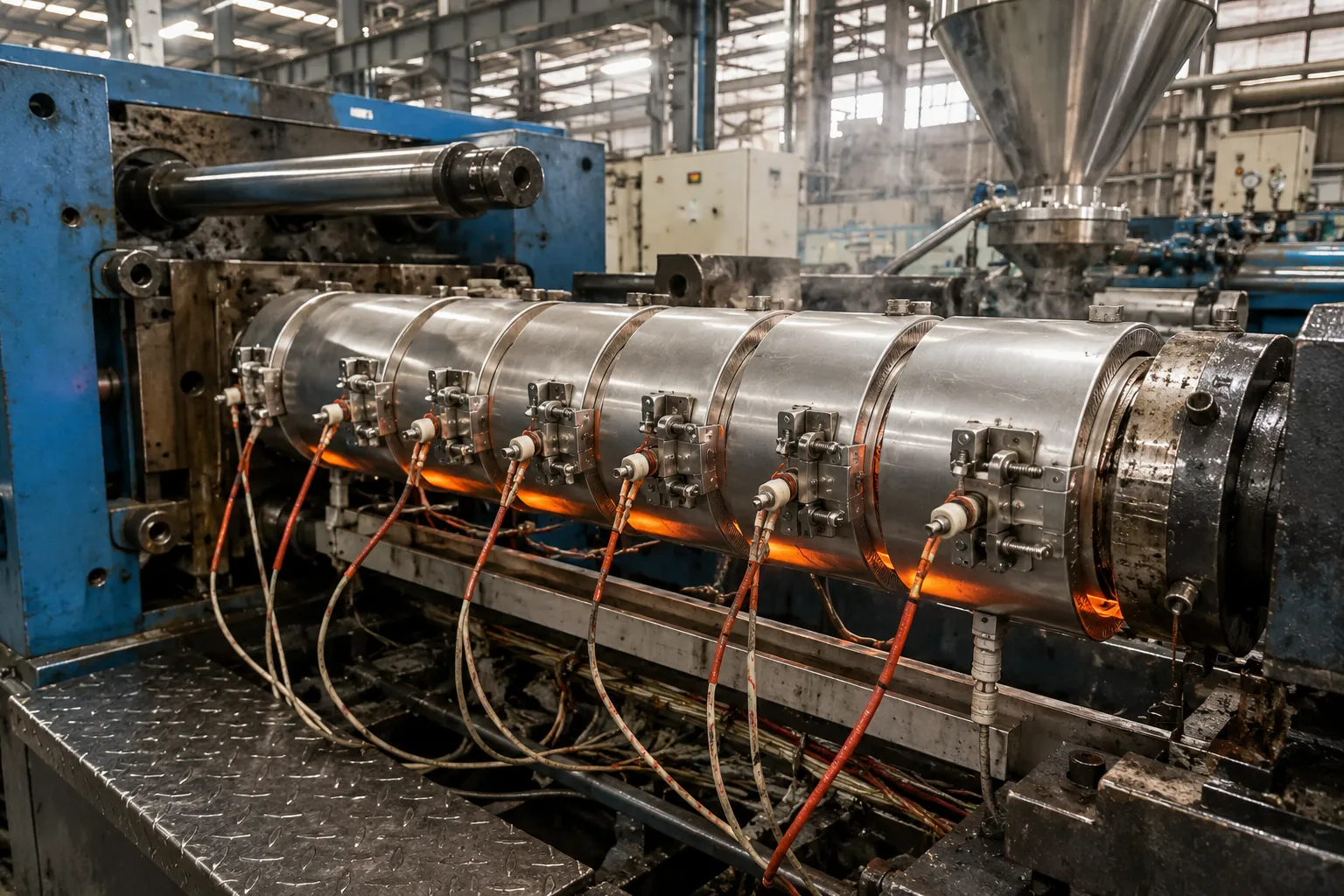
The mica band heater is the dominant heating element for plastic and rubber processing machinery across India. Here is how the major industries and machine types use them:
Injection Moulding Machines
The single largest application for mica band heaters in India. Every injection moulding machine has multiple barrel heating zones typically 3 to 6 zones from the feed zone to the nozzle each fitted with a mica band heater. Precise zone-by-zone temperature control is critical for melt viscosity consistency, which directly determines part dimensional accuracy, surface finish, and cycle time. India has hundreds of thousands of injection moulding machines operating across Pune, Aurangabad, Rajkot, Ahmedabad, Chennai, and the NCR region all requiring regular heater replacement.
Plastic Extruders
Extruder barrels are longer than injection moulding barrels and typically have 4 to 8 or more heating zones. The quality of mica band heaters on an extruder directly affects the melt temperature profile, which controls the molecular orientation, surface quality, and dimensional consistency of the extruded profile or film. Extruder heaters typically run continuously for long shifts and require higher long-term reliability than intermittently cycled injection moulding heaters.
Blow Moulding Machines
Blow moulding of bottles, containers, and hollow parts requires precise parison temperature control. Mica band heaters on the accumulator head and die zones are critical for parison wall thickness consistency. Uneven temperature across the die zone produces wall thickness variation that causes weak spots in the finished container a quality problem with real liability consequences in food and pharmaceutical packaging.
Hot Runner Systems and Dies
Hot runner manifolds and nozzles in multi-cavity moulds require very precisely specified, compact mica heaters. The temperature uniformity across a hot runner system directly determines the filling balance between cavities uneven temperature causes some cavities to short-shot while others flash. Hot runner heater specifications are exacting and replacement must be exact to the original dimensions.
Rubber Processing and Vulcanisation
Rubber compounding and calendering equipment, rubber extruders, and vulcanisation presses use mica band heaters and strip heaters for barrel and platen heating. The automotive belt around Pune supplying rubber seals, gaskets, hoses, and vibration dampers to India’s automotive OEMs is a significant market for quality rubber processing heaters.
Packaging, Food Processing, and Laboratory Equipment
Mica strip and plate heaters are used extensively in heat sealing machinery for packaging, in food processing hot plates and cooking equipment, and in laboratory analytical instruments. The food and pharmaceutical grades require SS316 sheaths and PTFE-insulated leads for hygiene compliance.
How to Choose the Right Mica Band Heater Supplier in India: 8 Questions to Ask
India has hundreds of mica band heater suppliers in India ranging from genuine manufacturing companies to small assembly workshops to pure traders who import Chinese elements and rebrand them. Here is how to identify a supplier worth trusting:
1. Do They Wind Their Own Resistance Elements?
This is the defining question. A genuine mica band heater manufacturer winds their own Nichrome resistance ribbon onto mica formers in-house. They control the ribbon grade selection, winding pitch, and coverage uniformity. An assembler buys pre-wound elements from third parties and wraps them into a sheath. Ask directly: do you perform resistance element winding in-house? If the answer is vague, treat the supplier as a trader.
2. What Is Their Ribbon Coverage Calculation Method?
A quality manufacturer calculates the exact ribbon coverage required to deliver the specified wattage at the correct watt density with even heat distribution and verifies this calculation before winding. REEW uses computer software for winding design, derived from 45 years of application experience. This is the difference between a heater that lasts 3 to 5 years and one that fails in 12 months.
3. Can They Supply Replacement Heaters for Imported Machines?
Many plants in Pune and across India run European, Japanese, or Taiwanese injection moulding machines with non-standard heater dimensions. A manufacturer with genuine in-house capability can reverse-engineer and reproduce any mica band heater from a sample or drawing including unusual diameters, non-standard widths, special terminal positions, or built-in thermocouple pockets. If a supplier can only supply standard sizes, they cannot help you when your Engel or Arburg machine heater fails.
4. What Is Their Quality Testing Process?
Every finished mica band heater should be tested for: electrical continuity (resistance measurement within tolerance), insulation resistance (megohm test at rated voltage), and dimensional accuracy (diameter and width within specified tolerance). Ask your potential supplier for their outgoing quality control protocol. REEW performs 100 percent testing on every element before dispatch.
5. What Sheath Materials and Terminal Options Do They Offer?
A credible manufacturer offers multiple sheath options (SS304, MS plated, brass inner for nozzle heaters) and terminal options (fibreglass leads, PTFE leads, ceramic terminal blocks, stainless terminal boxes, built-in thermocouples). Limited options indicate limited manufacturing capability.
6. Can They Supply Insulated (Energy-Saving) Versions?
The insulated mica band heater with ceramic wool outer jacket requires additional manufacturing steps and design capability. A manufacturer who can supply insulated versions has significantly higher engineering depth than one who only supplies standard bare heaters.
7. What Is Their Minimum Order Quantity and Lead Time?
For replacement heaters, you typically need small quantities quickly often 1 to 10 pieces when a machine breaks down. A genuine manufacturer serving the plastics industry understands this and carries sufficient mica, ribbon, and sheath stock to produce replacement heaters in 24 to 72 hours for standard specifications. A supplier with a 2-week minimum lead time for small orders is not set up to support your production continuity.
8. Do They Have References in Your Industry and City?
Ask for references from plastics processors or machine manufacturers in your area. A mica band heater manufacturer in Pune who has been supplying to the Pune and Aurangabad automotive plastics cluster for decades will have references you can call and verify. REEW has been supplying heaters to plastics processors, rubber manufacturers, and packaging companies across Maharashtra since 1980 our customer list is our longest-standing endorsement.
REEW: Mica Band Heater Manufacturer in Pune Since 1980
REEW Rajesh Electricals and Engineering Works has been manufacturing mica band heaters in Pune for over 45 years. We are a fully integrated heating element manufacturer we wind our own resistance elements, cut and form our own mica insulation, fabricate our own sheaths, and assemble every heater in our Pune facility. We do not assemble components sourced from third parties and call ourselves a manufacturer. Every REEW mica band heater is built in-house, from raw material to finished tested element.
| REEW Mica Band Heater Advantage | What It Means in Practice |
| In-house resistance ribbon winding computer-aided design | Uniform heat distribution, no hot spots, longer element life |
| SS304 standard sheath; MS plated, brass inner on request | Right material for every machine and application |
| Custom dimensions from 25 mm diameter and 20 mm width | Replacement for any machine including imported European and Japanese |
| Insulated (energy-saving) versions available | 20 to 30% electricity saving on high-production lines |
| 100% electrical and insulation testing before dispatch | Every heater delivered ready to perform |
| 24 to 48 hour turnaround on standard replacement orders | Minimum machine downtime when a heater fails |
| 45+ years supplying Pune’s plastics, rubber, and auto sector | Proven track record your competitors already rely on |
| Also manufactures tubular heaters and ceramic band heaters | Single supplier for all your heating element requirements |
More from the REEW Knowledge Base
These recent articles from the REEW blog go deeper on related industrial heating topics:
-> Tubular Heater Manufacturers in India: Complete Guide to Types and Applications
-> Industrial Oven Manufacturer in Pune: Complete Buyer’s Guide
-> Flux Baking Oven: Complete Guide Types, Temperatures, and How to Choose
-> Explore All REEW Heating Elements and Industrial Oven Products
Frequently Asked Questions: Mica Band Heater Manufacturer in Pune and India
Q1. What is a mica band heater and what is it used for?
A mica band heater is an electric resistance heater that uses muscovite mica as its insulating material. It is designed to clamp tightly around cylindrical surfaces primarily the barrels, nozzles, and dies of plastic injection moulding machines, extruders, and blow moulding equipment and transfer heat by direct conduction. It is the most widely used heating element in the plastics processing industry in India and globally.
Q2. What is the maximum temperature of a mica band heater?
Standard mica band heaters can operate at sheath temperatures up to 480 to 500 degrees Celsius. The mica insulation begins to degrade above this temperature, leading to reduced insulation resistance and eventual heater failure. For applications requiring barrel temperatures above 480 degrees Celsius typical with engineering polymers like PEEK, PPS, or high-temperature nylon a ceramic band heater is recommended instead.
Q3. What is the difference between a mica band heater and a ceramic band heater?
The primary differences are maximum operating temperature and energy efficiency. Mica band heaters operate up to approximately 480 to 500 degrees Celsius and are more cost-effective. Ceramic band heaters operate up to 650 to 700 degrees Celsius and have significantly lower radiated heat loss due to the ceramic tile insulation, making them more energy-efficient. For standard commodity plastics processing, mica heaters are usually the right choice. For engineering polymers and high-temperature applications, ceramic heaters are preferred. REEW manufactures both.
Q4. How long does a mica band heater last?
A correctly specified, quality-manufactured mica band heater on a properly maintained machine should last 2 to 5 years in continuous production use. Low-quality heaters with uneven winding, poor mica grade, or incorrect watt density often fail within 6 to 18 months. The most common causes of premature failure are: incorrect watt density specification, poor clamping allowing air gaps to develop, moisture ingress at terminals, and over-temperature due to thermocouple or controller failure. REEW heaters, with correct specification and proper installation, regularly achieve 3 to 7 years of service life.
Q5. How do I measure a mica band heater for replacement?
To order a replacement mica band heater, you need: the outer diameter of the barrel (which equals the inner diameter of the heater), the width (axial length) of the heating zone, the wattage, and the voltage. If you have the worn heater, measure these parameters from it. If the heater is from an imported machine, send REEW a photo and the measured dimensions we can manufacture an exact replacement. Also note the terminal type and lead insulation material of the original.
Q6. What causes mica band heaters to fail prematurely?
The most common causes of early mica band heater failure are: (1) Incorrect watt density the heater is over-rated for the barrel size, causing excessive internal temperatures. (2) Poor clamping air gaps between the heater and barrel surface cause the heater to overheat its own sheath. (3) Moisture ingress water or coolant contamination at the terminals causes insulation failure. (4) Mechanical damage barrels that are not cleaned before heater installation trap contamination that creates localised overheating. (5) Poor winding quality uneven ribbon spacing from low-quality manufacturers creates hot spots that burn out the resistance element.
Q7. Can REEW manufacture replacement mica band heaters for imported machines?
Yes this is one of REEW’s specialities as a mica band heater manufacturer in Pune. We regularly manufacture replacement heaters for Engel, Arburg, Demag, Husky, Fanuc, Toshiba, and other European and Japanese injection moulding machines where standard Indian catalogue sizes do not fit. Provide us with the worn heater or exact dimensional drawings and we will manufacture a precise replacement, typically within 24 to 48 hours for standard configurations.
Q8. What is an insulated mica band heater and is the extra cost worth it?
An insulated mica band heater adds a layer of ceramic wool insulation and an additional stainless steel outer jacket over a standard mica band heater. This prevents radiated heat loss heat that would otherwise be lost to the surrounding air resulting in 20 to 30 percent reduction in energy consumption for the same barrel temperature. For factories running 10 or more moulding machines in continuous production, the energy saving typically pays back the cost premium within 4 to 8 weeks. For high-production operations, insulated mica band heaters are always the better investment.
Q9. Where can I buy mica band heaters in Pune?
REEW (Rajesh Electricals and Engineering Works) is a leading mica band heater manufacturer in Pune with over 45 years of manufacturing experience. We supply directly to plastics processors, rubber manufacturers, packaging companies, automotive component makers, and machine manufacturers across Pune, Pimpri-Chinchwad, Chakan, Aurangabad, and the wider Maharashtra region. Call us at 08046077822 or visit www.reew.in for the full product range and to request a quotation.
Q10. Does REEW supply mica band heaters across India or only in Pune?
REEW is headquartered in Pune and supplies mica band heaters across India Maharashtra, Gujarat, Rajasthan, Delhi NCR, Tamil Nadu, Karnataka, Andhra Pradesh, Telangana, and West Bengal. We ship replacement heaters pan-India with typical dispatch within 24 to 48 hours for standard specifications. For large OEM supply contracts, we offer scheduled delivery programs with dedicated account management.
Q11. Can REEW supply both mica band heaters and the industrial ovens that use tubular heaters together?
Yes REEW is unique among Indian heating element manufacturers in being a fully integrated supplier of both mica band heaters, ceramic band heaters, tubular heaters, and complete industrial oven systems. This means that for a factory needing both barrel heaters for its moulding machines AND a curing oven or drying oven for its components, REEW is a single-source supplier with complete accountability for the entire thermal solution.
Conclusion: Your Mica Band Heater Supplier Is a Production-Critical Decision
The mica band heater is one of the smallest and least glamorous components in your factory and one of the most production-critical. When it fails, your injection moulding machine stops. When it underperforms, your melt temperature is inconsistent, your scrap rate rises, and your cycle time suffers. The cost of a bad heater decision is never just the cost of the heater.
Choosing the right mica band heater manufacturer in India is choosing a supplier who winds their own elements, designs to the right watt density, tests every piece before dispatch, and can deliver a replacement within 24 hours when your production is at risk. At REEW, we have been that supplier for the Pune plastics industry since 1980 and for manufacturers across India who have come to understand that the right mica band heater supplier in India is worth more than any saving on the heater price.
If you are ready to move from a commodity procurement decision to a genuine manufacturing partnership for your heater requirements, we would love to start that conversation.
| Need a Trusted Mica Band Heater Manufacturer in Pune?
REEW manufactures precision mica band heaters, ceramic band heaters, and tubular heaters from Pune, India since 1980. Every element is custom-wound, quality-tested, and backed by lifetime technical support. We supply pan-India to plastics, rubber, automotive, and packaging industries. Call: 08046077822 | Email: sales@rajeshele.com | Website: www.reew.in |