

If you work in welding, fabrication, or metal-joining industries, you already know that a poor-quality weld usually isn’t a poor-quality welder’s fault — it’s often a moisture problem. Damp welding flux absorbs atmospheric humidity, and that trapped moisture turns into hydrogen during welding, causing porosity, cracking, and brittle welds that fail under load.
This is exactly the problem a flux baking oven is built to solve.
At REEW Products, we’ve spent over four decades designing industrial heating systems — ovens, furnaces, and curing equipment — for automotive, pharmaceutical, electrical, and aerospace manufacturers. In this guide, we’ll walk you through exactly how a flux baking oven works, what temperature and capacity you actually need, and where it fits into your production line.
What Is a Flux Baking Oven ?
A flux baking oven is an industrial heating chamber used to dry and bake welding flux, brazing flux, or soldering flux to remove residual moisture before it’s used. By holding flux at a controlled temperature for a set duration, the oven prevents hydrogen-induced weld defects and keeps the flux’s chemical properties stable and consistent batch after batch.
Flux baking is a standard, code-mandated step in industries where weld integrity isn’t optional — pressure vessels, pipelines, structural steel, and shipbuilding, among others.
Why Flux Needs to Be Baked in the First Place ?
Welding flux (and brazing flux) is naturally hygroscopic — it pulls moisture straight out of the air, even during short storage or transport. Once that moisture is present :
- Hydrogen is released into the weld pool during welding
- The weld becomes prone to porosity, cracking, and reduced tensile strength
- Inconsistent flux moisture leads to inconsistent arc stability and bead quality
- Rejected welds mean rework, wasted material, and project delays
A properly designed flux baking oven eliminates this variable entirely, which is why quality-driven fabricators treat it as a non-negotiable step, not an optional one.
How a Flux Baking Oven Works : The Core Working Principle ?
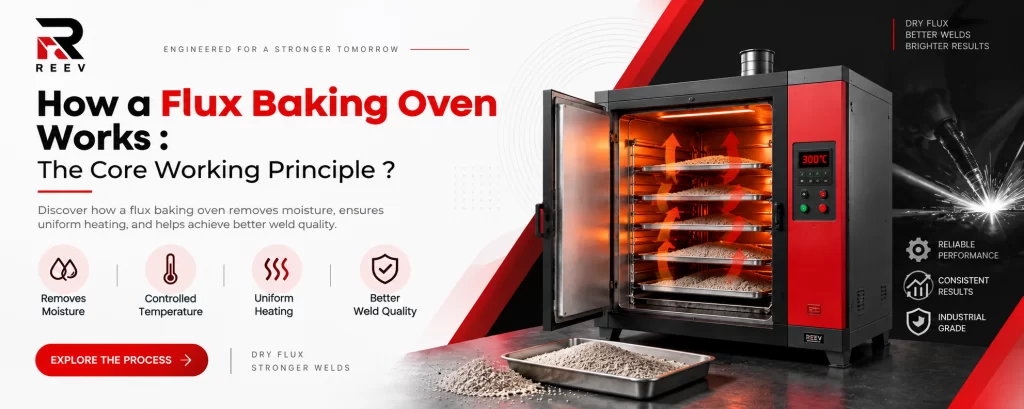
A flux baking oven works by circulating precisely controlled hot air around trays or containers of flux, driving out absorbed moisture through convection heating over a set time-temperature cycle. Here’s the step-by-step process:
- Loading: Flux is loaded into trays, baskets, or holding hoppers inside the oven chamber.
- Heating: Electric heating elements (typically finned-strip or tubular type) raise the internal chamber temperature to the required set point.
- Air Circulation: A motorised blower system forces hot air uniformly across every tray, avoiding hot or cold spots that would leave some flux under-baked.
- Moisture Extraction: As the flux heats, absorbed moisture evaporates and is exhausted out through a vent or duct system.
- Digital Control: A PID temperature controller monitors and maintains the exact temperature and soak time, often with data logging for quality audits (ISO/ASME/pressure-vessel code compliance).
- Holding (optional): Once baked, many fabricators transfer flux into a flux holding oven — a lower-temperature chamber — to keep it moisture-free right up to the point of use on the shop floor.
This two-stage approach — bake, then hold — is standard practice in serious welding operations, and it’s exactly why REEW manufactures both flux baking ovens and flux holding ovens as complementary equipment.
Flux Baking Oven Temperature: What's Actually Required?
Flux baking temperature typically ranges from 150°C to 450°C, depending on the flux type and the welding process (SMAW, SAW, or brazing). There’s no single universal number — the correct setting depends on the flux manufacturer’s data sheet and the applicable welding code.
| Flux/Process Type | Typical Baking Temperature | Typical Baking Duration |
|---|---|---|
| Basic-coated (low-hydrogen) SMAW electrodes | 300°C – 450°C | 1 – 2 hours |
| Submerged Arc Welding (SAW) agglomerated flux | 250°C – 350°C | 1 – 2 hours |
| Fused SAW flux | 150°C – 200°C | 1 – 2 hours |
| Brazing/soldering flux | 100°C – 150°C | 30 – 60 minutes |
| Holding oven (post-bake storage) | 100°C – 150°C | Continuous |
Practical insight: In our experience supplying ovens to fabrication shops, the single most common mistake isn’t picking the wrong temperature — it’s inconsistent airflow. A chamber can hit the right set-point on the display and still leave flux in low-circulation corners under-baked. That’s why tray spacing and blower design matter just as much as the temperature dial.
Flux Baking Oven Capacity : How to Choose the Right Size
Capacity is where most buyers either overspend or under-buy. Getting it right depends on three factors:
- Daily flux consumption — how many kilograms of flux your welding operation actually uses per shift
- Batch frequency — do you need continuous small batches, or one large bake per day?
- Floor space and workflow — is the oven feeding a single welding bay or an entire production floor?
Common industrial flux baking oven capacities range from 25 kg to 500+ kg per batch, available as:
- Small bench/trolley-type units — ideal for job shops and smaller fabrication units
- Multi-tray chamber ovens — for medium-to-large production with multiple flux types in rotation
- Custom high-capacity systems — built for shipyards, pressure vessel manufacturers, and heavy structural fabrication running continuous shifts
At REEW, we don’t push a one-size-fits-all unit. Every industrial flux baking oven we build is engineered against your actual daily flux volume, welding process, and available floor space — because an oversized oven wastes energy, and an undersized one becomes a production bottleneck.
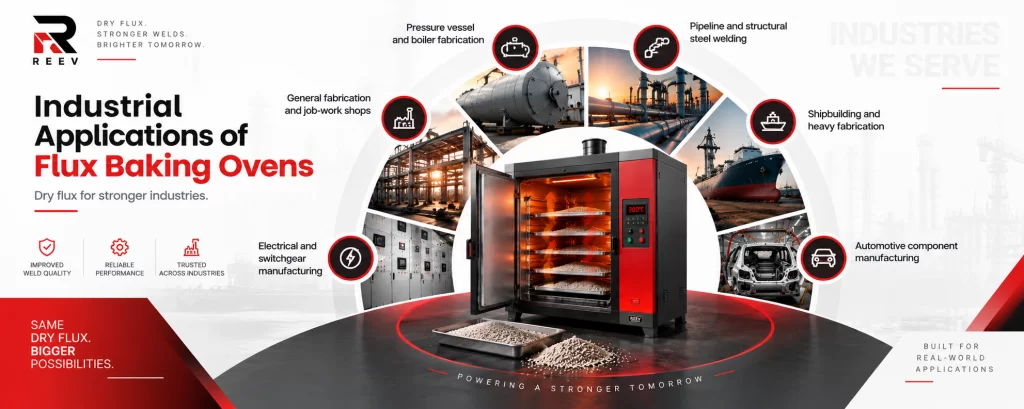
Industrial Applications of Flux Baking Ovens
Flux baking and holding ovens are used wherever weld quality is inspected, certified, or safety-critical :
- Pressure vessel and boiler fabrication — where code compliance (ASME, IBR) mandates controlled flux moisture
- Pipeline and structural steel welding — long, continuous welds where hydrogen cracking risk is high
- Shipbuilding and heavy fabrication — high-volume welding across large steel sections
- Automotive component manufacturing — brazing and soldering flux drying for consistent joint quality
- Electrical and switchgear manufacturing — soldering flux control for reliable electrical connections
- General fabrication and job-work shops — routine flux management as part of standard weld procedure
Flux Baking Oven vs. Flux Holding Oven: What's the Difference?
A flux baking oven actively removes moisture at higher temperatures over a defined cycle, while a flux holding oven maintains already-baked flux at a lower, steady temperature to prevent it from re-absorbing moisture before use. Think of baking as the “treatment” stage and holding as the “storage” stage — both are usually needed together in a compliant welding workflow.
Common Mistakes We See on the Shop Floor
- Skipping re-baking after long storage — baked flux left in open air for days can reabsorb moisture and needs re-treatment
- Ignoring manufacturer flux data sheets — every flux brand has a specific recommended bake temperature; guessing leads to inconsistent results
- Overloading trays — packing too much flux per tray blocks airflow and causes uneven baking
- No holding oven after baking — baked flux exposed to workshop humidity between baking and use defeats the purpose entirely
- No temperature logging — for code-compliant welding (ASME/IBR jobs), you need documented proof of bake cycles, not just a working thermostat
Why Manufacturers Choose REEW as Their Flux Oven Manufacturer in Pune ?
REEW Products (Rajesh Electricals and Engineering Works) has been designing and manufacturing industrial heating systems since 1980, serving automotive, pharmaceutical, industrial, electrical, and aerospace clients across India. Every oven, furnace, and heating system we build is designed, manufactured, tested, and pre-commissioned at our own factory before it ever leaves for your site — so you’re not the one discovering design flaws on your shop floor.
As a flux baking oven manufacturer and flux baking oven supplier in Pune, we build both standard and fully customised units — including combined baking-and-holding systems — backed by responsive after-sales support long after installation.
Conclusion
A flux baking oven isn’t a “nice to have” — for any operation where weld quality is inspected or certified, it’s a core piece of your quality system. Getting the temperature, capacity, and airflow design right is what separates a genuinely useful oven from an expensive metal box. If you’re evaluating a flux baking oven for your facility, start with your actual flux consumption and welding code requirements — then match equipment to that, not the other way around.
Looking for a reliable flux baking oven manufacturer? REEW Products designs and builds custom flux baking and holding ovens engineered around your exact production needs. Get in touch with our engineering team for a consultation, or explore our full oven range.
FAQ SECTION
A flux baking oven is used to remove moisture from welding, brazing, or soldering flux before it's used, preventing hydrogen-related weld defects like porosity and cracking. It's a standard quality step in fabrication shops working to welding codes.
Baking temperature depends on flux type — basic-coated SMAW electrodes typically need 300°C–450°C, while SAW flux ranges from 150°C–350°C. Always check the flux manufacturer's data sheet, since temperatures vary by brand and process.
Most industrial flux baking cycles run for 1–2 hours at the specified temperature, though brazing and soldering flux often needs only 30–60 minutes. Duration depends on flux volume, tray loading, and the oven's airflow design.
A flux baking oven actively dries flux at higher temperatures, while a flux holding oven keeps already-dried flux warm at a lower, steady temperature to stop it reabsorbing moisture before use. Most compliant welding setups use both.
Capacity depends on your daily flux consumption, batch frequency, and welding volume — industrial units commonly range from 25 kg to 500+ kg per batch. A manufacturer can size the right unit once they know your shift-wise flux usage.
Yes — flux left exposed to workshop air for an extended period (typically more than a few hours, depending on humidity) can reabsorb moisture and should be re-baked or moved to a holding oven immediately after the first bake.