


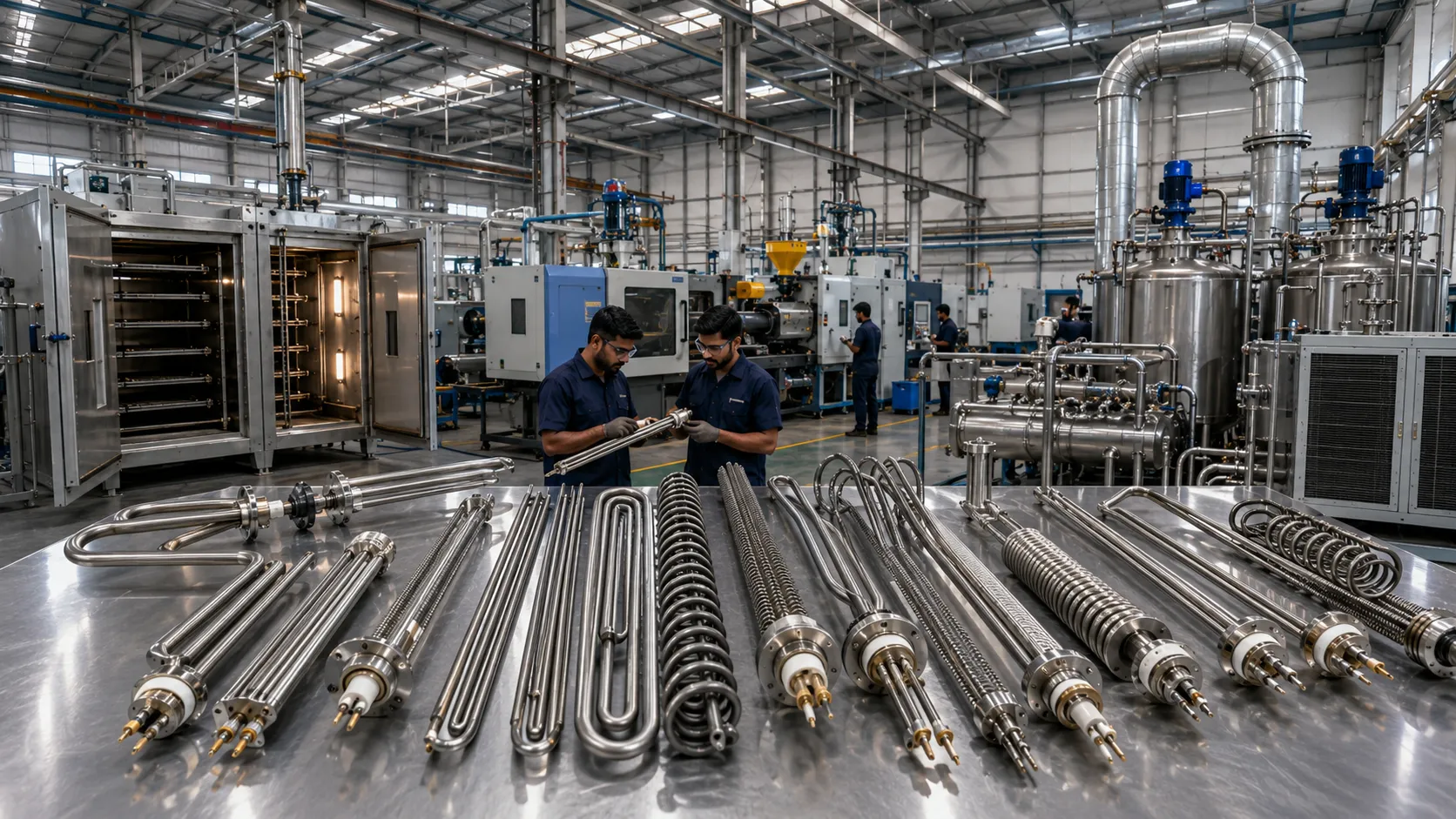
The tubular heater is the single most versatile electric heating element ever designed — and in 45 years of manufacturing industrial heating solutions at REEW, I can say with complete conviction that I have never encountered an industrial heating application where a well-specified tubular heater did not either solve the problem or form the core of the solution.
That is not an overstatement. From a small bakery oven in Pune to a massive submerged arc welding flux baking installation for a shipyard in Vizag, from a pharmaceutical granule dryer in Nashik to a chemical process tank heater in Surat — tubular heaters are at the heart of industrial thermal processes across every sector in India. They are the most widely used electric heating element in the world, and for very good reason.
But here is what I have learned after decades as a tubular heater manufacturer in India: the quality difference between a well-engineered tubular heater and a cheaply produced one is enormous — and it is never visible from the outside. Both look like a metal tube. But one will last 8 to 12 years in continuous industrial service. The other will fail in 18 months and take your production line with it.
This guide gives you everything you need: how tubular heaters work, every major type and where each belongs, the industries that depend on them, what separates quality from junk, and how to find a tubular heater supplier in India you can actually trust. Let us start from the beginning.
What Is a Tubular Heater? Working Principle and Construction
A tubular heater — also called a tubular heating element or electric tubular heater — is a resistance-based electric heating element constructed from a metal sheath enclosing a coiled resistance wire (typically Nichrome or Kanthal alloy), with the space between the wire and sheath packed with magnesium oxide (MgO) powder as electrical insulation and heat-transfer medium.
The MgO filling is the critical engineering detail that most buyers never see and never think about — until it fails. High-density MgO packing ensures efficient heat transfer from the resistance wire to the sheath, minimises hot spots, and provides the dielectric strength that keeps the element safe at high voltages. Low-quality MgO packing — a common corner-cut among cheap tubular heater manufacturers in India — creates hot spots that burn out the resistance wire prematurely.
How a Tubular Heater Works — Step by Step
- Electrical current flows through the resistance wire (Nichrome/Kanthal) inside the sheath
- Resistance of the wire converts electrical energy into heat
- Heat conducts outward through the MgO insulation to the metal sheath
- The sheath transfers heat to the surrounding medium — air, water, oil, or the surface it contacts
- Temperature is controlled by a thermostat, PID controller, or SCR power regulator
Key Construction Materials
| Component | Material Options | Where It Matters |
| Resistance Wire | Nichrome (NiCr80/20), Kanthal A1, FeCrAl | Higher alloy grade = longer life at high temp |
| Sheath / Outer Tube | SS304, SS316, SS310, Incoloy 800, Incoloy 840, Copper, Steel | Match to medium: SS316 for corrosive liquids, Incoloy for 900°C+ |
| Insulation Fill | Magnesium Oxide (MgO) powder | Density and purity directly determine element life |
| End Seal | Ceramic, Silicon, Teflon compound | Prevents moisture ingress — critical for immersion elements |
| Terminals | SS pins, Copper lugs, Ceramic terminal block | Match to voltage and connection method |
Types of Tubular Heaters: Complete Classification
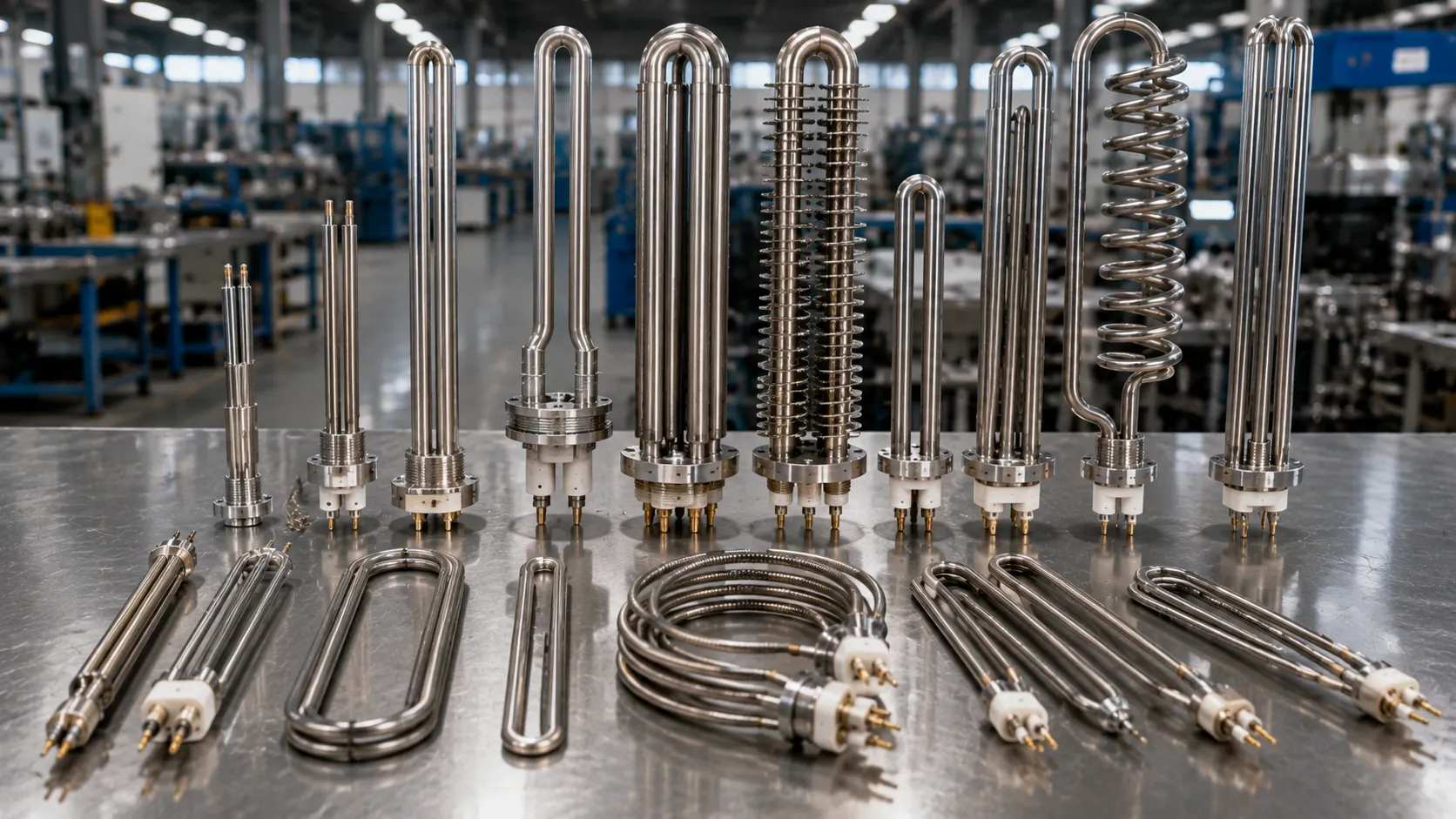
One of the greatest strengths of the tubular heater is that it can be formed into virtually any shape during manufacturing — straight, U-shaped, L-shaped, coiled, helical, or custom-bent to fit any oven, tank, or machine geometry. Here are the principal types:
1. Straight Tubular Heaters
The most basic form. Single-ended (both terminals at one end) or double-ended (one terminal at each end). Used in industrial ovens, air heaters, drying chambers, and as cartridge replacement elements. Lengths from 100 mm to 3000+ mm. Diameters: 6.5 mm, 8 mm, 10 mm, 12.5 mm, 16 mm standard.
- Applications: Industrial oven air heating, platen heating, drying chambers, food equipment
- Sheath: SS304 standard; SS316 / Incoloy for high-temperature or corrosive applications
- Mounting: Ceramic ferrules, screw flanges, or slip-fit into heater holes in oven walls
2. U-Shaped Tubular Heaters
The most widely used configuration in industrial ovens and industrial furnaces. Both terminals exit from the same side, making installation and replacement straightforward. The U-bend extends deep into the heating chamber, maximising heat distribution.
- Applications: Industrial ovens (curing, drying, powder coat), industrial furnaces, box ovens
- Advantage: Easy one-side access for maintenance and replacement
- REEW U-shaped tubular heaters: Available in SS304, SS316, and Incoloy 800 sheaths
3. Finned Tubular Heaters
A straight or shaped tubular heater with steel or aluminium fins welded or wound onto the sheath to dramatically increase the surface area for convective heat transfer to air or gas. Finned tubular heaters transfer heat 3 to 5 times more effectively to flowing air compared to bare tubular heaters of the same wattage.
- Applications: Duct heaters, air handling units (AHUs), forced-air industrial ovens, space heating
- Key parameter: Fin pitch, fin height, and fin material determine thermal performance
- Industries: HVAC, industrial process air heating, drying tunnels
4. Immersion Tubular Heaters
Designed to be immersed directly in liquid media — water, oil, chemical solutions, plating baths, or molten metals. The sheath material must be matched precisely to the liquid being heated. Using SS304 in chloride-containing liquids, for example, causes rapid corrosion failure — a costly lesson many Indian factories have learned the hard way.
- Applications: Water heating tanks, oil heating, electroplating baths, chemical process tanks, hot water systems
- Sheath selection: SS316 for aqueous and mildly corrosive; Incoloy 800/840 for oils at high temp; Titanium for aggressive acids
- Critical feature: Over-temperature protection and accurate watt density calculation to prevent film boiling
5. Coiled / Ring-Form Tubular Heaters
Tubular heaters bent into circular, oval, or spiral forms to fit specific vessel geometries. Commonly used in the base of tanks, drum heaters, and large industrial kettles. Also used as complete replaceable heating assemblies in hot-water storage systems.
- Applications: Industrial tanks, chemical vessels, food processing kettles, hot water systems
6. Double-Ended / Single-Ended Straight Elements
Double-ended elements have one terminal at each end — used when both sides of a platen or oven wall are accessible. Single-ended (hairpin) elements have both terminals at one end — used in applications where only one-side access is available such as injection moulding platens, die-casting dies, and cartridge heater replacements.
| Type | Shape | Primary Application | Key Selection Factor |
| Straight Tubular | Linear | Ovens, platen heating, drying | Length, watt density, sheath material |
| U-Shaped Tubular | U-bend | Industrial ovens and furnaces | Leg length, terminal clearance |
| Finned Tubular | Linear + fins | Duct heaters, forced-air ovens | Fin pitch, airflow velocity |
| Immersion Tubular | Straight/U/Coiled | Liquid heating, plating, tanks | Sheath vs liquid compatibility |
| Coiled / Ring Form | Circular/Spiral | Tanks, kettles, vessels | Vessel diameter, heat output |
| Single-Ended (Hairpin) | U with close legs | Platens, dies, moulds | Hole diameter, insertion depth |
Watt Density: The Most Important Specification Nobody Tells You About
If there is one technical concept every buyer of a tubular heater must understand, it is watt density — the amount of power (watts) per unit of heater surface area (cm2 or in2). It is the single most important factor in determining heater life, and it is where most cheap heaters cut corners.
A high watt density means more heat per unit area. This sounds like a good thing — but run a heater at too high a watt density for its application and you will burn out the resistance wire, crack the MgO insulation, and fail the element in months. Run it at the correct watt density and the same element will perform reliably for a decade or more.
| Medium Being Heated | Recommended Watt Density | Reason |
| Still Air (no forced flow) | 0.8 – 1.5 W/cm2 | Low convective cooling; must limit surface temperature |
| Forced Air (fan-assisted) | 2.0 – 4.0 W/cm2 | Higher airflow removes heat more effectively |
| Water (low flow) | 3.0 – 6.0 W/cm2 | Water is an excellent heat conductor |
| Transformer / Mineral Oil | 1.5 – 3.0 W/cm2 | Lower thermal conductivity than water; risk of cracking |
| Chemical / Plating Solutions | 1.0 – 2.5 W/cm2 | Conservative rating to avoid localised boiling and corrosion |
| Viscous Oils / Heavy Media | 0.5 – 1.5 W/cm2 | Poor conductivity; high risk of overheating if over-rated |
| Critical Buying Advice: Always ask your tubular heater manufacturer to confirm the watt density calculation for your application before ordering. A supplier who quotes a heater without asking about the medium, flow rate, and operating temperature is giving you a guess — not an engineering solution. |
| Need a Trusted Tubular Heater Manufacturer in India?
REEW manufactures precision tubular heaters, mica band heaters, and ceramic band heaters from Pune since 1980. Every element is custom-wound, quality-tested, and backed by lifetime technical support. We supply pan-India. Call: 08046077822 | Email: sales@rajeshele.com | Website: www.reew.in |
Industrial Applications of Tubular Heaters in India
The tubular heater is not a niche product — it is the backbone of electric heating across Indian manufacturing. Here is how major industries use them:
Industrial Ovens and Furnaces
The single largest application for tubular heaters in India. U-shaped and straight tubular elements are the primary heating source in batch ovens, conveyor ovens, curing ovens, drying ovens, and heat treatment furnaces. At REEW, every industrial oven we manufacture is fitted with our own in-house produced tubular heating elements — this is how we guarantee both oven performance and element longevity as a tubular heater manufacturer in India.
Plastic and Rubber Processing
Extruder barrel heating, injection moulding platen heating, rubber vulcanisation press heating, and blow moulding die heating. The plastics industry in Pune, Aurangabad, and around Rajkot is one of the largest consumers of tubular heating elements in India.
Pharmaceutical and Chemical Industry
Reactor vessel heating, chemical tank immersion heating, API intermediate drying, granule drying ovens, and autoclave heating. Pharmaceutical applications require SS316L sheaths for cleanliness, and precise watt density control to prevent local overheating of sensitive compounds.
Food Processing
Baking ovens, fryer heating elements, pasteurisation tank immersion heaters, food dryers, and cooking equipment. Food-grade applications require SS304 or SS316 sheaths with food-safe end sealing and smooth weld-free surfaces to prevent contamination build-up.
Water and Oil Heating
Industrial hot water systems, oil pre-heating tanks, mould temperature controllers, hydraulic oil heaters, and heat transfer oil circuits. Correct watt density is especially critical for oil heating to prevent oil cracking and carbon deposit formation on the heater sheath.
HVAC and Duct Heating
Finned tubular heaters are extensively used in industrial duct heaters, air handling units, and space heaters across industrial facilities. The fin geometry is selected based on air velocity and required temperature rise across the duct.
Flux Baking Ovens and Electrode Dryers
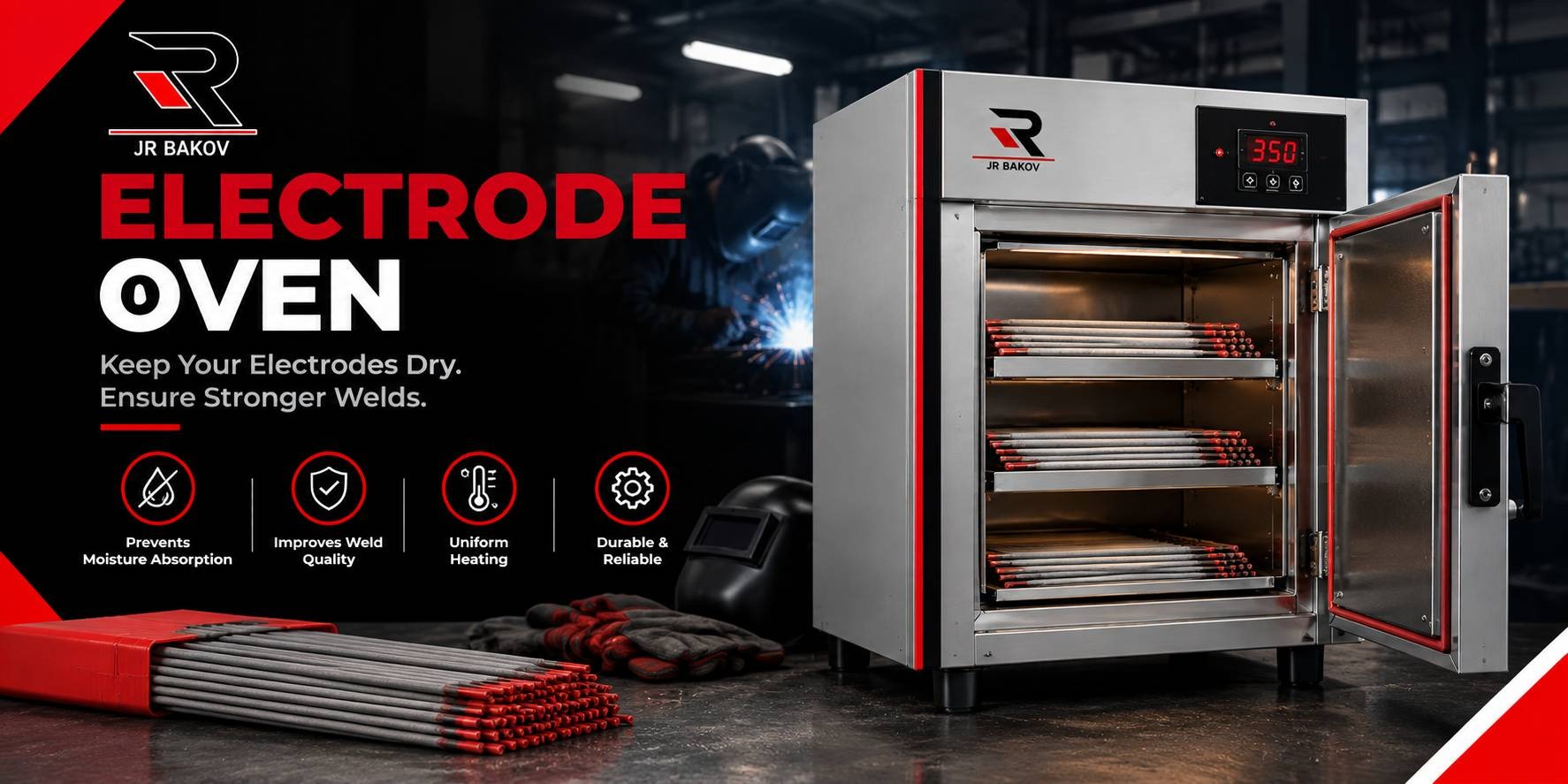
A highly specialised application where tubular heaters operate continuously at 150°C to 400°C inside welding flux reconditioning ovens. REEW supplies complete flux baking ovens and electrode holding ovens using our own manufactured tubular heating elements — ensuring full system integration and single-source accountability.
How to Choose the Right Tubular Heater Supplier in India: 7 Things That Matter
India has no shortage of tubular heater suppliers in India. But the gap between a quality manufacturer and a cheap assembler is enormous — and it shows up only after 12 to 18 months of operation, when the failures start. Here is how to separate the genuine tubular heater manufacturers in India from the pretenders:
1. Do They Manufacture or Just Assemble?
A genuine tubular heater manufacturer controls the winding of the resistance element, the MgO fill process, the swaging (compression) operation, and the quality testing. An assembler buys pre-made elements from third parties, cuts them to length, and fits terminals. The difference in quality is significant — and the accountability gap when something fails is total.
2. What Is Their MgO Fill Quality Control?
This is the question that separates experts from amateurs. Ask your potential tubular heater supplier what MgO purity grade they use, how they measure fill density, and what quality checks they perform on the swaged element before finishing. If they cannot answer clearly, their process quality is doubtful.
3. Sheath Material Options and Traceability
A quality manufacturer stocks multiple sheath materials — SS304, SS316, SS310, Incoloy 800, Incoloy 840 — and provides material test certificates (MTCs) upon request. This matters enormously for pharmaceutical, food, and chemical applications where material traceability is a regulatory requirement.
4. Watt Density Engineering Capability
Will they calculate the correct watt density for your specific application, or just supply what you ask for? A manufacturer with genuine engineering capability will ask about your medium, flow conditions, and operating temperature — and recommend the appropriate specification. One who just takes your order without asking is setting you up for premature failure.
5. Testing Before Dispatch
Every quality tubular heater should be tested for electrical continuity, insulation resistance (megohm test), and hi-pot (dielectric) strength before dispatch. Ask your supplier for their outgoing quality control process. REEW performs 100% testing on every element before it leaves our Pune facility.
6. Custom Bending and Forming Capability
Can they form elements to your exact required shape? Custom bending capability — for U-shapes, L-shapes, coiled forms, or completely custom profiles — without damaging the MgO packing requires skilled equipment and experience. This is a genuine differentiator between manufacturers and resellers.
7. Warranty and Replacement Support
A reputable tubular heater manufacturer stands behind their product with a clear warranty and fast replacement support when failures occur. Ask about warranty terms, failure analysis capability, and typical response time for replacement supply.
Why REEW Is One of the Most Trusted Tubular Heater Manufacturers in India
REEW — Rajesh Electricals and Engineering Works — has been manufacturing tubular heaters, mica band heaters, ceramic band heaters, and complete industrial oven systems from Pune since 1980. As one of the few fully integrated tubular heater manufacturers in India that also manufactures the industrial ovens that use them, we have a level of application knowledge that pure element manufacturers simply do not have.
| What REEW Delivers | What It Means for You |
| In-house resistance winding and MgO fill | Full quality control from raw material to finished element |
| SS304, SS316, SS310, Incoloy 800/840 sheath options | Right material for every application — not just SS304 as default |
| Watt density engineering for every order | Elements sized correctly for your medium and duty cycle |
| 100% electrical and insulation testing before dispatch | No surprises after installation |
| Custom bending: straight, U, L, coil, finned, special forms | Exact fit for your oven, tank, or machine geometry |
| 45+ years of industrial oven integration experience | Elements that work perfectly in your system from day one |
| Pan-India supply from Pune — Maharashtra, Gujarat, Goa and beyond | Fast delivery and local support across India |
Related Heating Elements: Mica Band Heaters and Ceramic Band Heaters
While tubular heaters are the most versatile electric heating element, two closely related products serve specific applications where tubular elements are not the right choice:
Mica Band Heaters
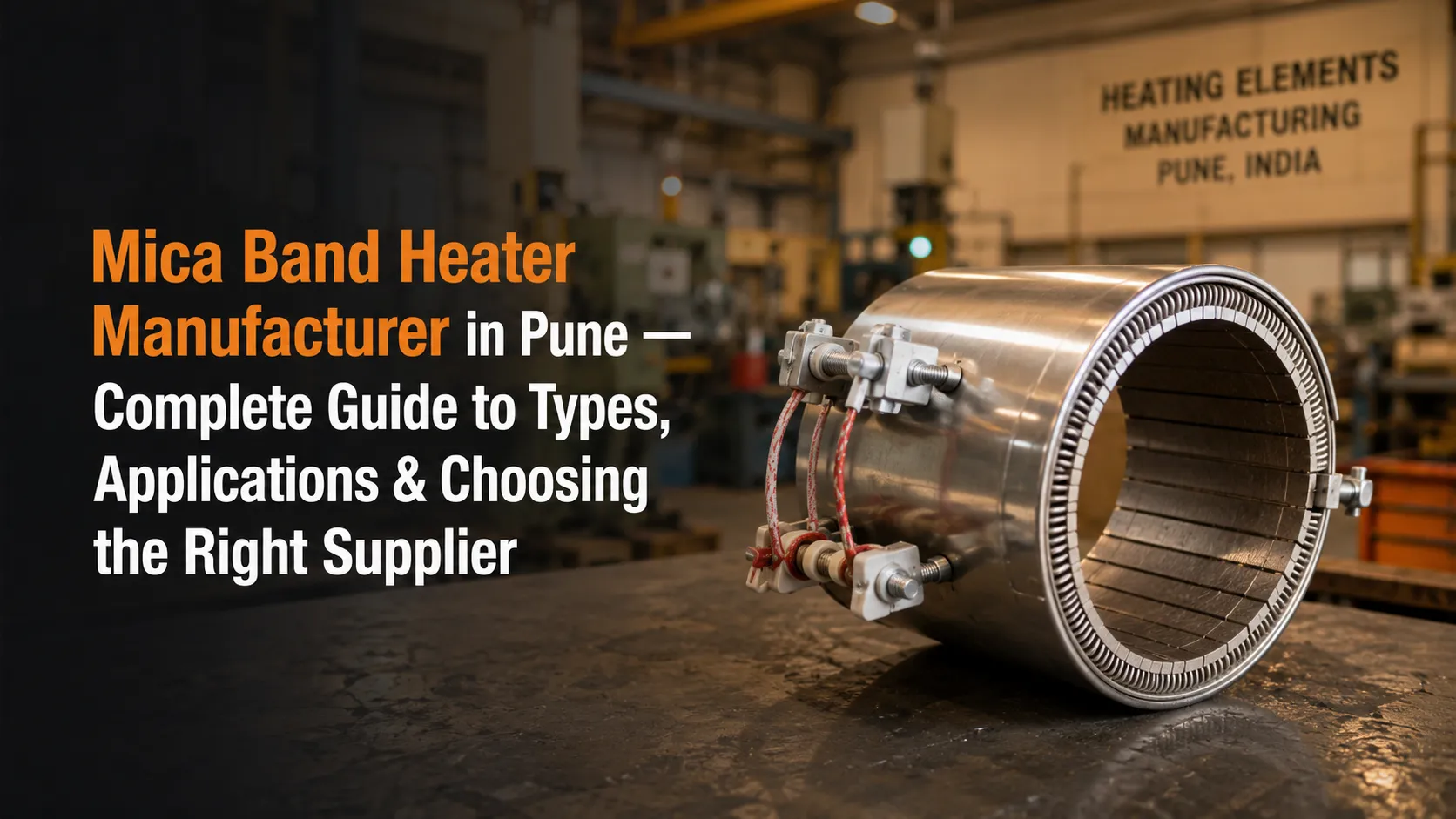
Mica band heaters are thin, flexible heaters that clamp around cylindrical surfaces — most commonly injection moulding machine barrels, extruder barrels, and hot runner nozzles. The heating element (resistance wire) is sandwiched between sheets of mica insulation inside a stainless steel outer shell. REEW is an established mica band heater manufacturer in Pune, supplying the plastics processing industry across India.
- Typical temperature range: Up to 450°C
- Key advantage: Thin profile, excellent contact with barrel surface, fast heat-up
- Industries: Injection moulding, extrusion, blow moulding, hot runner systems
Ceramic Band Heaters
Ceramic band heaters use ceramic tiles to insulate the resistance element, which allows them to operate at higher temperatures than mica band heaters — typically up to 700°C or beyond. The ceramic construction also reduces radiated heat loss and improves energy efficiency. REEW manufactures ceramic band heaters for high-temperature extruder and moulding machine applications.
- Typical temperature range: Up to 650°C+
- Key advantage: Higher temperature capability, lower external temperature (safer operation)
- Industries: High-temperature extrusion, engineering polymer processing
| Need a Trusted Tubular Heater Manufacturer in India?
REEW manufactures precision tubular heaters, mica band heaters, and ceramic band heaters from Pune since 1980. Every element is custom-wound, quality-tested, and backed by lifetime technical support. We supply pan-India. Call: 08046077822 | Email: sales@rajeshele.com | Website: www.reew.in |
More from the REEW Knowledge Base
These recent articles go deeper on industrial heating topics closely related to tubular heaters:
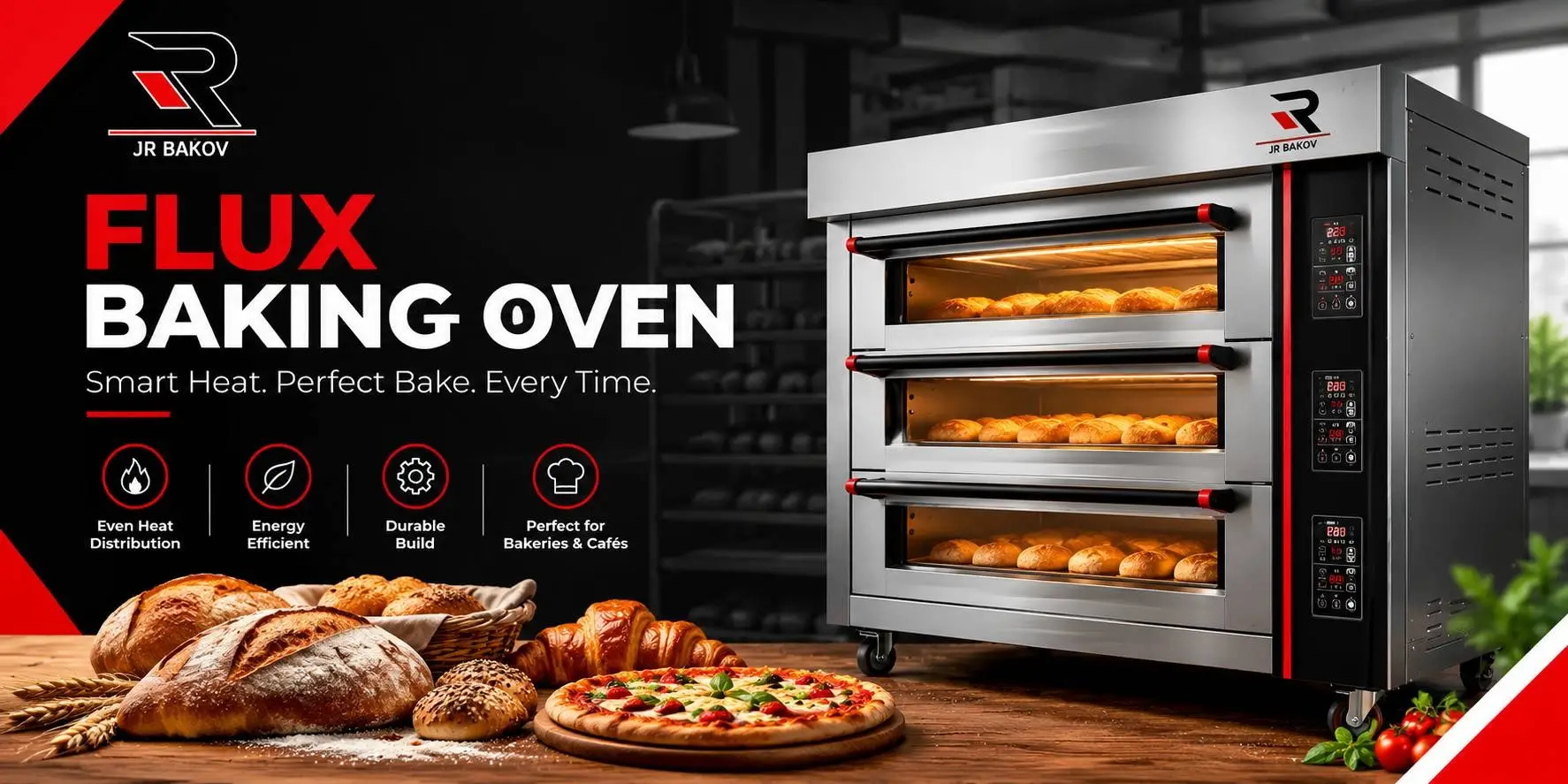
-> Flux Baking Oven: Complete Guide — How They Work, Types, and How to Choose One
-> Industrial Oven Manufacturer in Pune and India: Complete Buyer’s Guide
-> Industrial Oven Supplier in Pune — How to Find the Right Manufacturing Partner
-> Explore All REEW Heating Elements and Industrial Oven Products
Frequently Asked Questions: Tubular Heater Manufacturers in India
Q1. What is a tubular heater and how does it work?
A tubular heater is an electric resistance heating element consisting of a Nichrome or Kanthal resistance wire coil inside a metal sheath (typically SS304, SS316, or Incoloy), with the gap filled with magnesium oxide (MgO) powder for insulation and heat transfer. When electrical current passes through the resistance wire, it generates heat which conducts through the MgO to the sheath and then to the surrounding medium — air, water, oil, or a contact surface.
Q2. What are the different types of tubular heaters?
The main types are: straight tubular heaters, U-shaped tubular heaters (most common in industrial ovens), finned tubular heaters (for air and duct heating), immersion tubular heaters (for liquid heating), coiled or ring-form heaters (for tanks and vessels), and single-ended or double-ended hairpin heaters (for platens and dies). Each type suits specific installation geometries and heat transfer requirements.
Q3. Which sheath material should I choose for my tubular heater?
The sheath material must be matched to the medium and operating temperature. SS304 works for dry air heating, non-corrosive liquids, and food contact applications. SS316 is preferred for water, aqueous solutions, and mildly corrosive chemicals. SS316L is used for pharmaceutical and food-grade applications requiring material traceability. Incoloy 800 or 840 is used for applications above 600 to 700 degrees C or in high-sulfur environments. Copper sheathed elements suit some water and oil heating applications. If in doubt, contact REEW — we will recommend the correct material for your application.
Q4. What is watt density in a tubular heater and why does it matter?
Watt density is the power output per unit of heater surface area (W/cm2). It determines the surface temperature of the heater sheath. If watt density is too high for the medium being heated, the sheath surface temperature becomes too high, causing element burn-out, oil cracking, chemical decomposition, or food scorching. The correct watt density depends on the medium, its thermal conductivity, and flow conditions. REEW engineers watt density correctly for every order rather than applying a one-size-fits-all specification.
Q5. How long does a tubular heater last?
A quality tubular heater, correctly specified for its application (right watt density, right sheath material, correct installation), typically lasts 8 to 15 years in continuous industrial service. Low-quality tubular heaters from unverified suppliers — with poor MgO fill density, incorrect watt density, or unsuitable sheath material — often fail within 12 to 24 months. The heater cost is a tiny fraction of the downtime cost when a heater fails inside a production oven or process tank.
Q6. What is the difference between a tubular heater and a cartridge heater?
A tubular heater is a flexible element that can be bent into various shapes and is used for air heating, liquid immersion heating, and surface heating. A cartridge heater is a rigid, high-power-density element designed to be inserted into precision-drilled holes in metal platens, moulds, and dies for high-watt-density conduction heating. Cartridge heaters are a separate product category — REEW produces both.
Q7. Can REEW supply custom-shaped tubular heaters?
Yes — REEW manufactures custom-shaped tubular heaters to any required geometry: straight, U-shaped, L-shaped, coiled, ring-form, W-shape, or completely custom-bent profiles for special oven and machine geometries. We also manufacture finned tubular heaters for duct and air heating applications. Provide us your installation drawing or dimensional requirements and we will engineer and manufacture the exact element.
Q8. What is the price of tubular heaters in India?
Tubular heater pricing in India depends on the sheath material, diameter, length, watt rating, and quantity. Basic SS304 straight elements start from approximately Rs. 150 to Rs. 500 per element for standard sizes. Custom-shaped, Incoloy-sheathed, or high-watt-density elements for demanding applications are priced higher. Contact REEW for a precise quotation with full technical specification — we do not supply unspecified elements at catalogue prices, because the specification is what determines performance.
Q9. What industries does REEW supply tubular heaters to?
REEW supplies tubular heating elements across India to: automotive and EV manufacturing, pharmaceutical and chemical processing, food processing, industrial oven and furnace manufacturers, plastics and rubber processing, HVAC and duct heating, shipbuilding and offshore, pipeline and heavy fabrication, electrical panel heating, water and oil heating systems, and defence manufacturing. From Pune and Maharashtra across the length of India.
Q10. How do I get a quotation from REEW for tubular heaters?
Call REEW at 08046077822, or email sales@rajeshele.com with your requirements: sheath material, diameter, length, wattage, voltage, shape, and medium to be heated. If you are unsure of the specification, share your application details and our engineering team will recommend the correct specification. You can also visit www.reew.in for our full product range.
Conclusion: The Right Tubular Heater Manufacturer Changes Everything
A tubular heater that is correctly specified, properly manufactured, and installed in the right application is the most reliable heating component in your factory. It will run quietly, efficiently, and without drama for years — often for more than a decade. The wrong tubular heater — under-specified, poorly filled, or made from the wrong sheath material — will fail within months and cost you multiples of its purchase price in downtime and rework.
That is why choosing the right tubular heater manufacturer in India is not a procurement decision to make on price alone. It is an engineering decision. At REEW, every element we supply comes with the application engineering that makes it perform. We have been doing this from Pune since 1980, and our clients across India trust us not just to supply elements — but to get the specification right every time.
If you are ready for a conversation about your tubular heater requirements — or about the industrial oven, furnace, or process heating system those elements need to go into — we would genuinely love to hear from you.
| Need a Trusted Tubular Heater Manufacturer in India?
REEW manufactures precision tubular heaters, mica band heaters, and ceramic band heaters from Pune since 1980. Every element is custom-wound, quality-tested, and backed by lifetime technical support. We supply pan-India. Call: 08046077822 | Email: sales@rajeshele.com | Website: www.reew.in |
Comments (2)
Mica Band Heater Manufacturer in Pune: Complete Guide to Types, Applications, and How to Choose the Right Mica Band Heater Supplier in India - Reew
says July 29, 2026 at 9:20 am[…] -> Tubular Heater Manufacturers in India: Complete Guide to Types and Applications […]
Mica Band Heater Manufacturer in Pune | REEW Since 1980
says September 10, 2026 at 12:01 pm[…] -> Tubular Heater Manufacturers in India: Complete Guide to Types and Applications […]