In any welding operation that uses submerged arc welding (SAW) or similar processes, the quality of your weld is only as good as the condition of your flux. Moisture-contaminated flux leads to porosity, hydrogen cracking, and poor weld integrity — defects that can cause structural failures in critical applications.
The solution is a flux baking oven — a precision heating unit designed to recondition and activate welding flux before use.
If you are a manufacturer, fabricator, or welding contractor in Pune, Maharashtra, or anywhere in India, this guide will help you understand everything you need to make the right purchasing decision.
What Is a Flux Baking Oven?
A flux baking oven — also called a flux drying oven or flux rebaking oven — is a specialised industrial oven designed to heat welding flux to precise temperatures, removing absorbed moisture and restoring the flux to its optimal chemical and physical state.
Welding flux, especially the granulated flux used in submerged arc welding (SAW), is hygroscopic. This means it naturally absorbs moisture from the surrounding atmosphere. Even a small amount of moisture in your flux can cause serious welding defects.
A flux baking oven eliminates this problem by heating the flux to temperatures between 250°C and 400°C, driving off all absorbed moisture before the flux is used in production.
Why Flux Conditioning Is Non-Negotiable in Industrial Welding
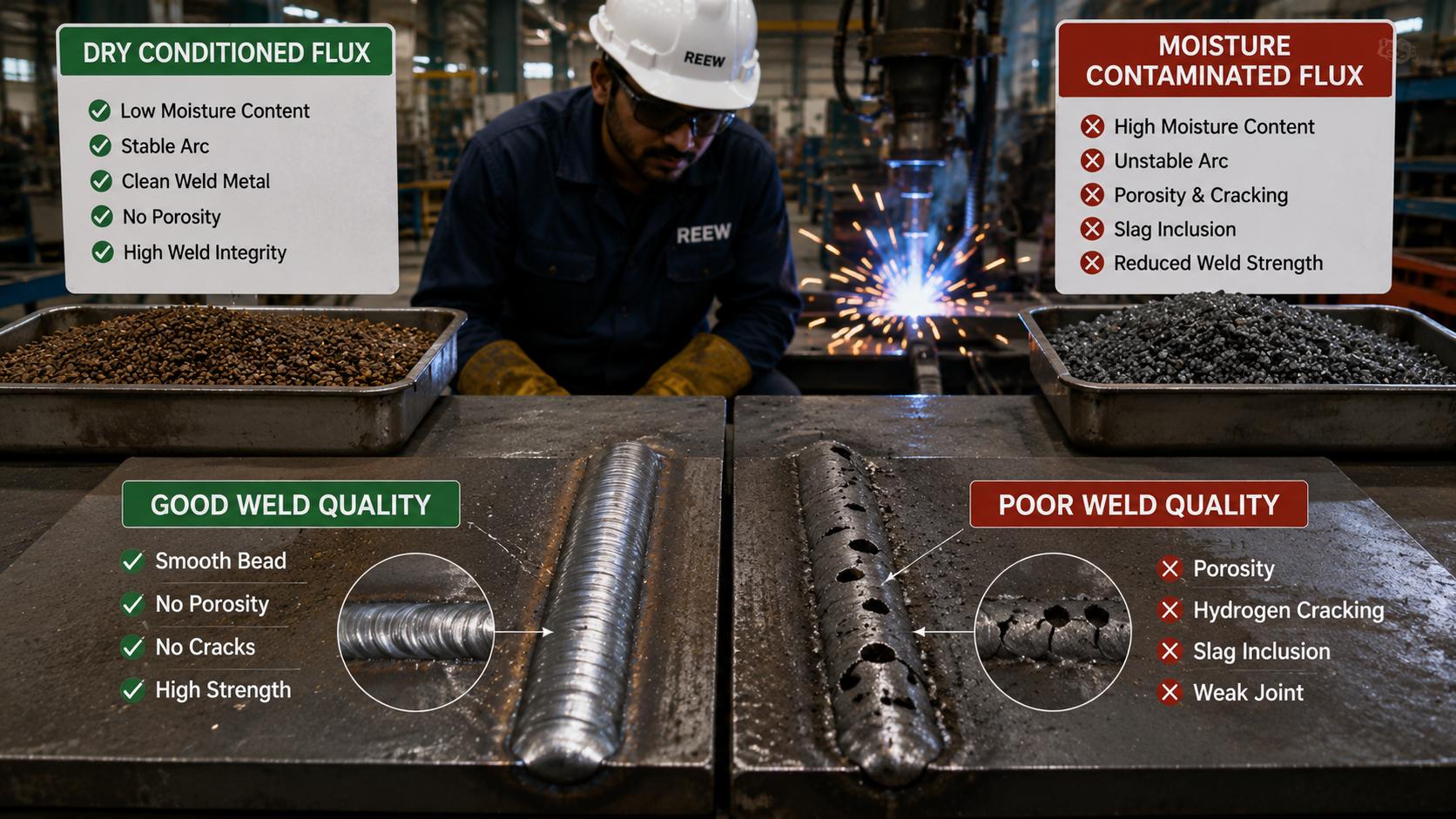
Many welding operations in India — particularly in pipe fabrication, shipbuilding, pressure vessel, and structural steel industries — rely on SAW flux for high-deposition, high-speed welding. The risks of using wet or improperly stored flux include:
- Hydrogen-Induced Cracking (HIC)
Moisture in flux introduces hydrogen into the weld pool. Hydrogen atoms diffuse into the steel and cause delayed cracking — often appearing hours or days after welding. In pressure vessels or pipelines, this is catastrophic.
- Porosity
Water vapour trapped in the weld pool creates gas pores. Porous welds fail ultrasonic and radiographic testing, leading to expensive rework.
- Slag Inclusion
Improper flux conditioning leads to unstable slag systems, resulting in slag inclusions that weaken the weld.
- Reduced Arc Stability
Wet flux produces erratic arc behaviour, making it difficult to maintain consistent weld parameters.
These defects are entirely preventable with the correct use of a quality industrial flux baking oven.
Types of Flux Baking Ovens
Flux baking ovens come in several configurations. Understanding the differences helps you choose the right equipment for your specific workflow.
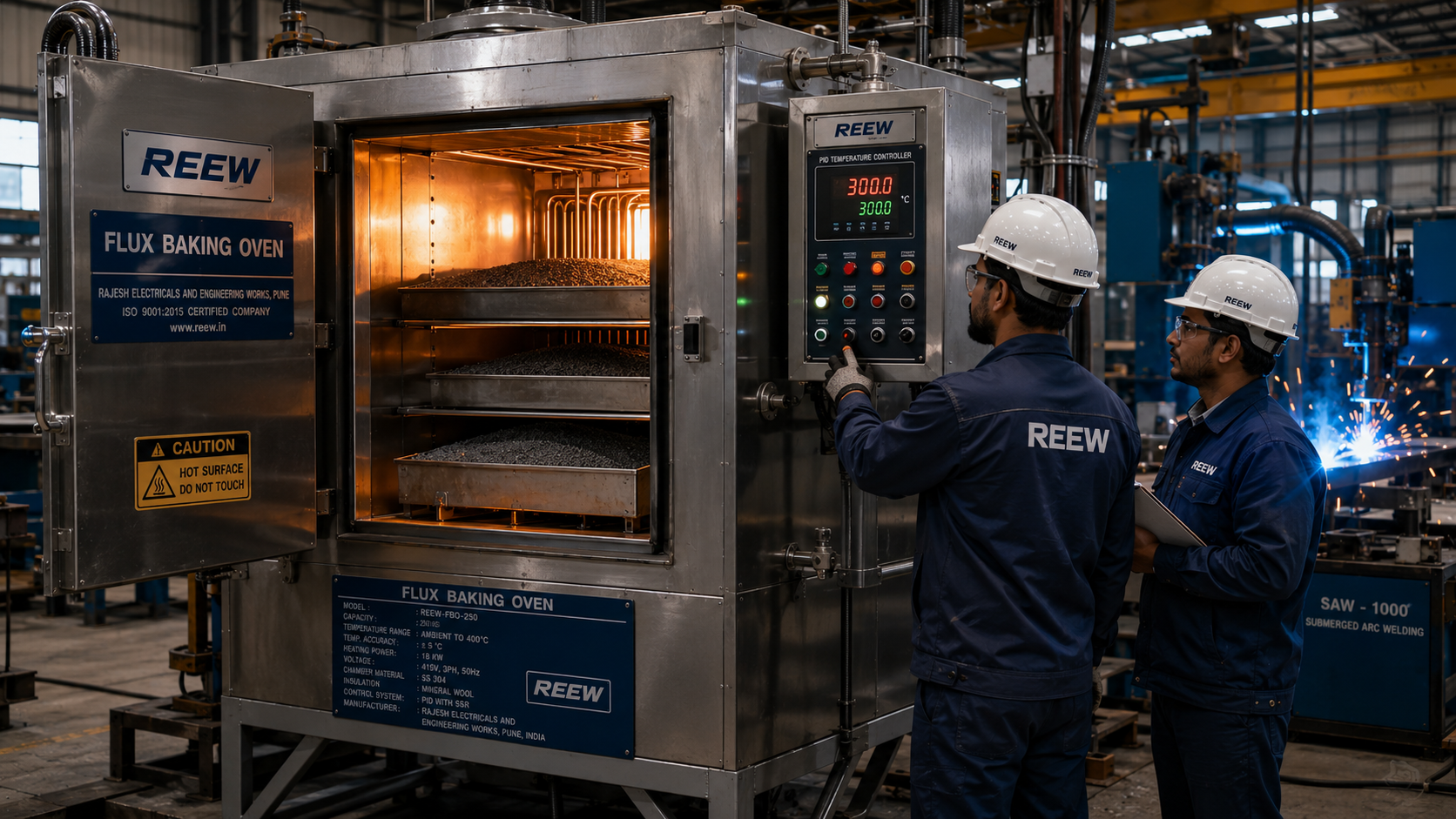
1. Front-Loading Flux Baking Oven
The most common type in Indian welding workshops. Flux is loaded through a front door into an insulated chamber. Available in capacities from 50 kg to over 1,000 kg.
Best for: General fabrication shops, structural steel manufacturers, welding workshops with moderate throughput.
Key features:
- Front door with heat-resistant gasket sealing
- Digital temperature controller with PID accuracy
- Stainless steel inner chamber (SS 304 or SS 316)
- Mineral wool insulation for energy efficiency
- Available in single-phase and three-phase configurations
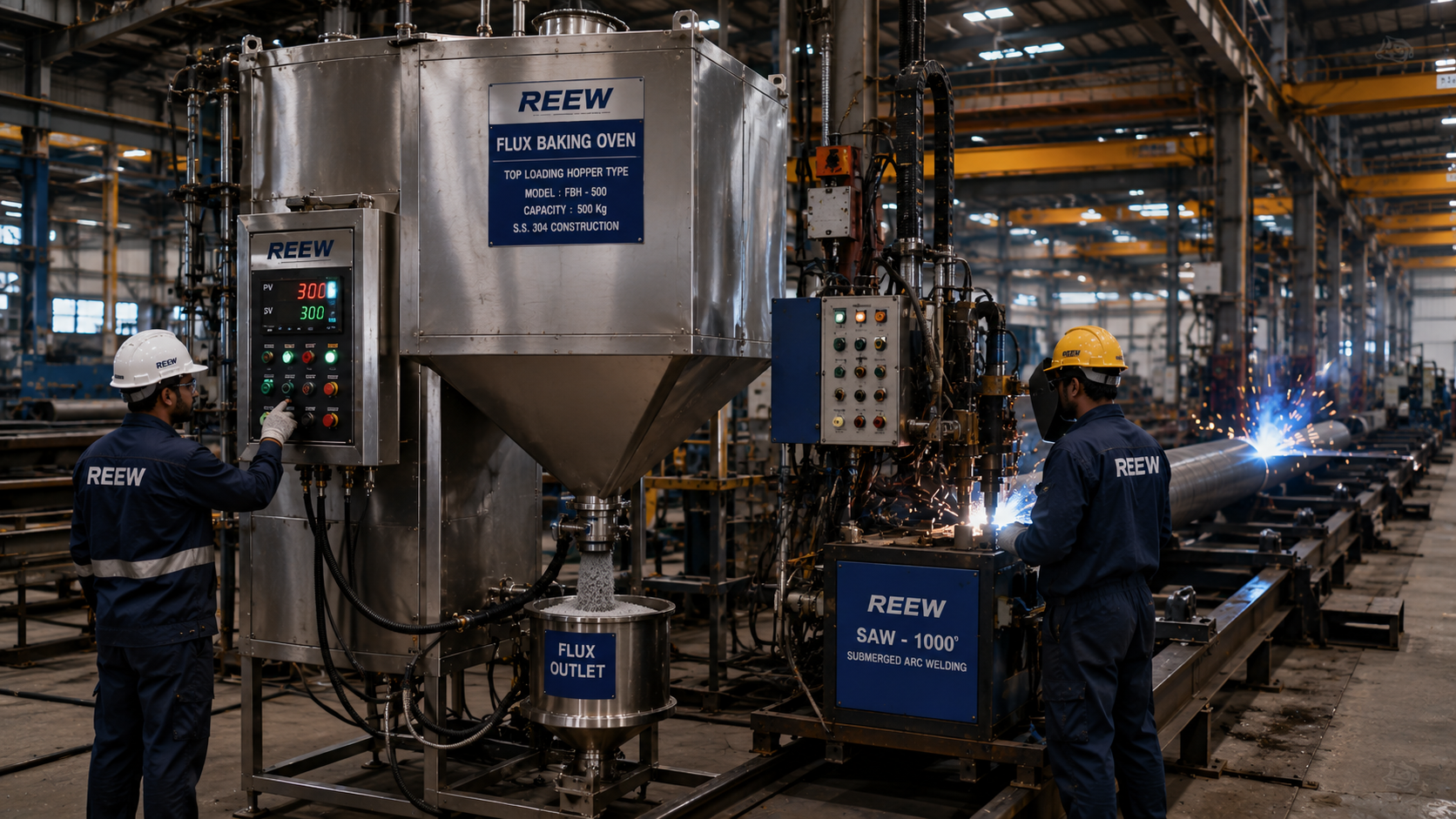
2. Top-Loading (Hopper-Type) Flux Baking Oven
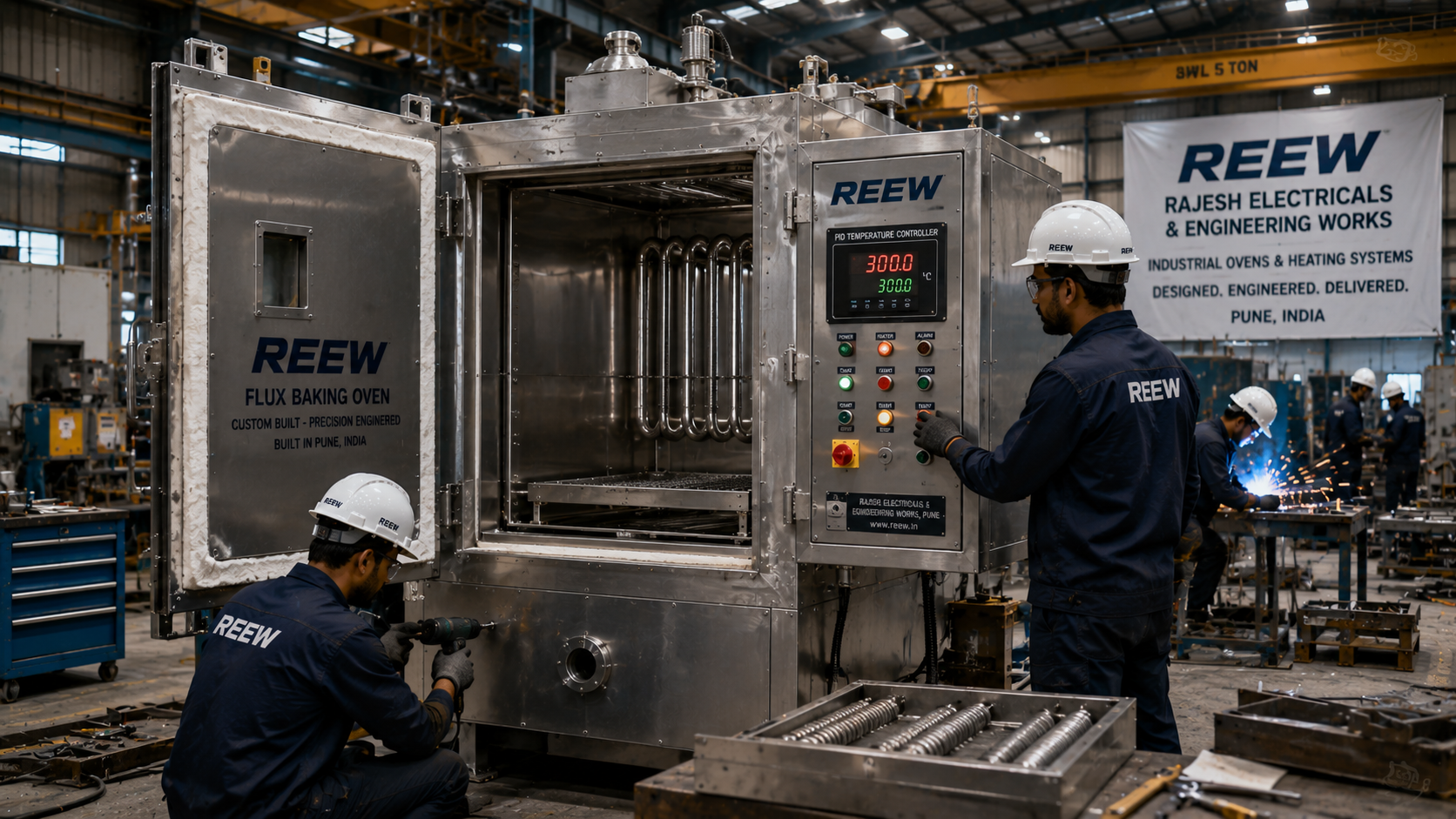
The hopper-style design is particularly suited for submerged arc welding operations. Flux is loaded from the top and dispensed through a bottom outlet valve directly to the SAW machine’s flux hopper, ensuring zero contact with ambient air between conditioning and use.
Best for: Heavy fabrication plants, pressure vessel manufacturers, pipeline welding operations.
Key features:
- Top loading, bottom dispensing — no moisture reabsorption
- No direct contact between flux and heating elements
- SS 304 inner hopper with smooth outlet valve
- Temperature range: Ambient to 400°C
- Pneumatic door options available for automated operations
3. Portable / Carry Flux Oven
Compact and lightweight, designed for site use. Capacity typically between 5 kg and 25 kg. Battery or 230V single-phase operation.
Best for: Pipeline welding sites, field repair operations, remote construction projects.
4. Large Capacity Industrial Flux Baking Oven
For high-volume SAW operations, ovens with capacities from 500 kg to 2,000 kg are available. These industrial-scale units are often custom-designed to integrate directly into the welding line.
Best for: Shipyards, ERW pipe mills, large boiler manufacturers.
Correct Temperature Settings for Flux Baking
One of the most critical aspects of flux conditioning is using the correct temperature. Under-baking leaves residual moisture; over-baking can chemically alter the flux or damage its granule structure.
| Flux Type | Recommended Temperature | Holding Time |
| Agglomerated SAW Flux | 250°C – 300°C | 1–2 hours |
| Fused SAW Flux | 150°C – 200°C | 1 hour |
| Basic Coated Electrodes Flux | 300°C – 400°C | 1–2 hours |
| High-Cellulosic Flux | 70°C – 100°C | 30–60 minutes |
Always refer to the flux manufacturer’s data sheet for specific baking parameters. REEW’s flux baking ovens come with programmable PID controllers that allow you to set and hold precise temperatures according to these requirements.
After baking, flux should be transferred directly to a flux holding oven maintained at 100°C–150°C to prevent moisture reabsorption before use.
Key Technical Specifications to Look For
When sourcing a flux baking oven from a manufacturer in Pune or anywhere in India, these are the specifications that matter most:
| Specification | What to Look For |
| Temperature Range | Ambient to 400°C minimum, ±5°C accuracy, PID controller |
| Chamber Material | SS 304 or SS 316 stainless steel inner chamber |
| Insulation | High-density mineral wool or ceramic fibre |
| Heating Elements | Nichrome or Kanthal wire, no direct contact with flux |
| Temperature Uniformity | ±10°C across chamber |
| Safety Features | Over-temp protection, door interlock, earthing terminals |
How Flux Baking Ovens Are Used in Industry
Shipbuilding and Offshore Fabrication
Ships and offshore platforms are built using kilometres of SAW welds. The consequences of weld failure in these environments are severe. Shipyards in India maintain strict flux conditioning protocols, with flux baking ovens integral to every welding bay.
Pressure Vessel and Boiler Manufacturing
Pressure vessels are subject to rigorous inspection standards (IS 2825, ASME Section VIII). Weld quality must meet radiographic and ultrasonic testing requirements. Flux baking is mandatory in most quality management systems for pressure vessel fabrication.
Pipeline Welding
Long-distance pipelines for oil, gas, and water use SAW and SMAW processes extensively. Proper flux conditioning is specified in pipeline welding codes such as API 1104 and BS 4515.
Structural Steel Fabrication
Large structural steel fabricators — building bridges, stadiums, and industrial structures — use flux baking ovens to maintain weld quality on high-volume production lines.
REEW: Your Trusted Flux Baking Oven Manufacturer in Pune
REEW (Rajesh Electricals and Engineering Works) has been manufacturing precision industrial ovens and heating systems from Pune since 1980. As a dedicated flux baking oven manufacturer in Pune, REEW brings over four decades of experience to every product.
What Makes REEW Flux Baking Ovens Different
Custom Engineering — Every REEW flux baking oven is engineered to your specific requirements. Capacity, configuration (front-loading or top-loading), temperature range, and control system are all designed around your process, not the other way around.
Superior Insulation — REEW ovens use high-density mineral wool insulation that minimises heat loss, reduces electricity consumption, and maintains temperature stability even during frequent door-opening cycles.
PID Temperature Control — All REEW flux baking ovens are fitted with digital PID controllers, providing accurate temperature regulation with setpoint memory and over-temperature alarm functions.
Stainless Steel Construction — Inner chambers in SS 304 grade material resist corrosion and chemical attack. Outer cabinets are fabricated from mild steel with industrial-grade powder coating.
After-Sales Service — REEW provides commissioning, calibration, and maintenance support across Pune and Maharashtra. Spare heating elements, controllers, and thermocouples are available from stock.
REEW Flux Baking Oven Capacity Range
| Capacity | Best For | Configuration |
| 50 kg | Small welding workshops | Front-loading |
| 100 kg | Medium fabrication shops | Front-loading / Top-loading |
| 250 kg | Continuous production environments | Top-loading hopper |
| 500 kg+ | Large industrial plants | Custom design |
Flux Baking Oven vs Electrode Baking Oven
A common source of confusion among buyers is the difference between a flux baking oven and an electrode baking oven. Both are used in welding operations, but they serve different purposes:
| Feature | Flux Baking Oven | Electrode Baking Oven |
| Purpose | Condition SAW or brazing flux | Dry/recondition coated electrodes |
| Temperature | 150°C – 400°C | 100°C – 450°C |
| Configuration | Hopper / front-loading | Shelved chamber |
| Capacity measure | Kilograms of flux | Number/weight of electrodes |
| Typical users | SAW welding operations | SMAW / manual welding |
REEW manufactures both types. If your operation uses a combination of SAW and SMAW processes, REEW can supply both ovens or a dual-purpose unit.
Frequently Asked Questions
What is the purpose of a flux baking oven?
A flux baking oven removes absorbed moisture from welding flux, restoring it to its optimal condition. Properly baked flux prevents weld defects like porosity and hydrogen cracking.
What temperature should flux be baked at?
Most agglomerated SAW flux requires baking at 250°C–300°C for 1–2 hours. Fused flux requires 150°C–200°C. Always refer to your flux manufacturer’s data sheet for specific parameters.
How long does flux stay conditioned after baking?
Once baked, flux should be transferred to a holding oven maintained at 100°C–150°C. If exposed to open air, flux begins reabsorbing moisture within hours in humid conditions.
What is the difference between front-loading and top-loading flux ovens?
Front-loading ovens work like standard ovens. Top-loading hopper-type ovens are designed for SAW operations — flux is loaded from the top and dispensed at the bottom directly to the welding head, minimising air exposure.
Can REEW make a custom-capacity flux baking oven?
Yes. REEW designs and manufactures flux baking ovens in custom capacities from 50 kg to 2,000 kg+. Contact REEW’s team to discuss your requirements.
Do you supply flux baking ovens outside Pune?
Yes. REEW supplies industrial ovens and heating equipment across Maharashtra and pan-India. Installations have been completed in Mumbai, Nashik, Aurangabad, Chennai, and other cities.
What is the power consumption of a flux baking oven?
Power consumption depends on capacity and insulation quality. A 100 kg REEW flux baking oven typically consumes 2–4 kW during temperature maintenance (holding phase), significantly less than the initial heat-up phase.
Conclusion
Flux conditioning is not an optional step in quality welding — it is a fundamental requirement for weld integrity, safety, and compliance with industry standards. Choosing the right flux baking oven from a reliable flux baking oven manufacturer in Pune directly impacts the quality of every weld your team produces.
REEW has supplied precision flux baking ovens to welding operations across India for over four decades. Whether you need a compact 50 kg front-loading unit for a workshop or a 500 kg hopper-type oven for a pipeline fabrication plant, REEW engineers a solution built around your requirements.
| Ready to discuss your flux baking oven requirements?
Contact REEW – Rajesh Electricals and Engineering Works, Pune Phone: 08046077822 | Email: sales@rajeshele.com | Website: reew.in |
About REEW (Rajesh Electricals and Engineering Works)
REEW is a Pune-based industrial oven and heating system manufacturer with over 40 years of experience. The company designs, manufactures, and supplies industrial ovens, furnaces, heating elements, and control systems for the automotive, pharmaceutical, electrical, and heavy engineering industries across India.