


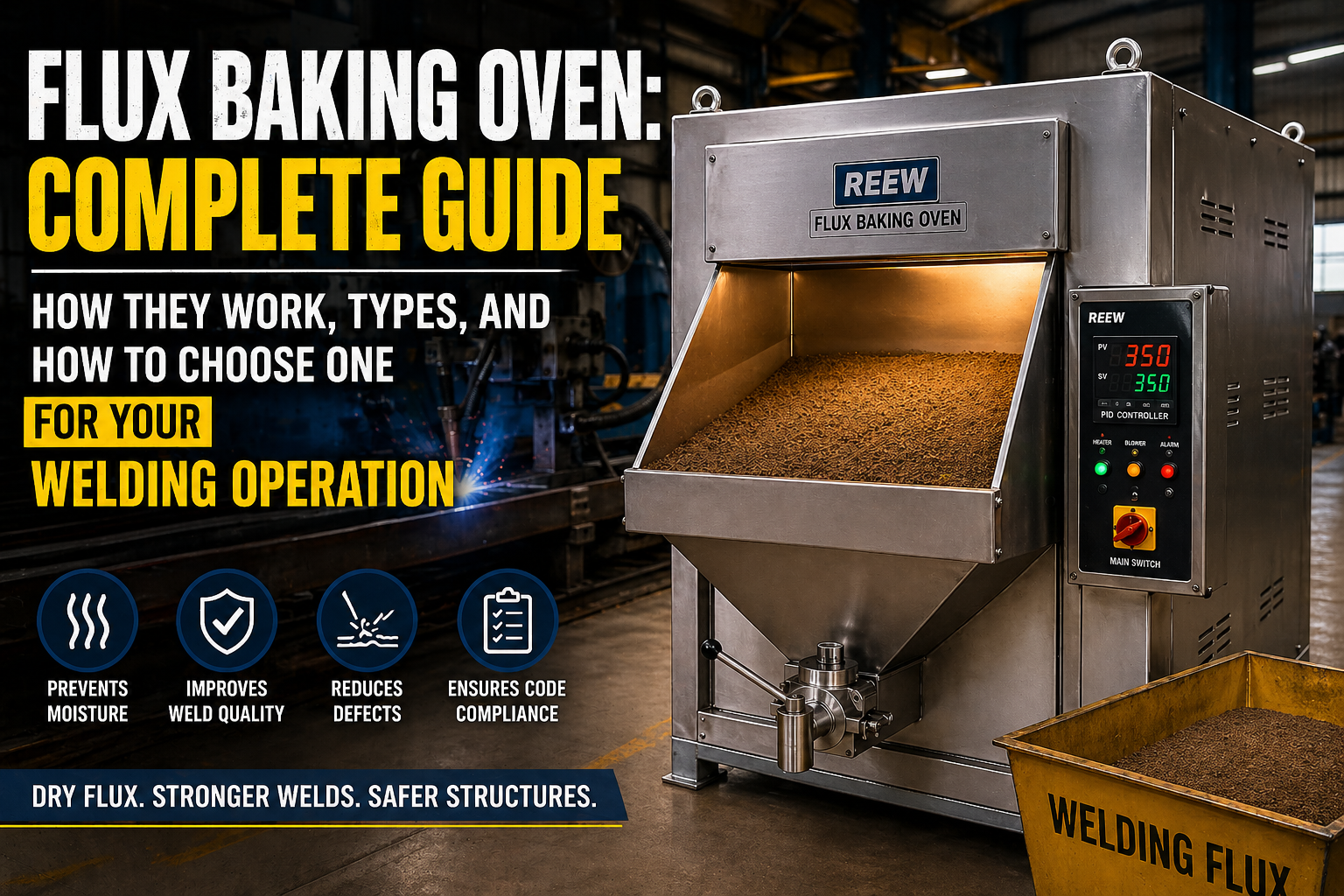
A flux baking oven is one of those pieces of equipment that welding professionals either swear by — or deeply regret not investing in sooner. I have spent decades at REEW designing and supplying these ovens to some of India’s leading automotive, shipbuilding, and pipeline companies, and I can tell you one thing with absolute certainty: moisture in your welding flux is a silent killer of weld quality. The moment I walk into a fabrication shop and see flux bags lying open on the floor near the welding station, I know exactly why their welds are failing.
This complete guide is the one I wish existed when I first started in the industrial heating industry. Whether you are a procurement manager trying to justify the purchase, a welding engineer diagnosing porosity issues, or a fabrication unit in Pune looking for the right flux baking oven manufacturer — this article is written for you. We will cover everything: how a flux baking oven works, the different types available in India, what to look for when buying one, and which industries benefit most.
| Quick Tip: If you are already familiar with what flux baking ovens do and want to jump straight to ‘How to Choose the Right Flux Baking Oven,’ scroll to Section 5. Otherwise, read from the top — the background context will help you make a much better buying decision. |
What Is a Flux Baking Oven? (Definition + Context)
A flux baking oven — also commonly called a flux drying oven, flux rebaking oven, or welding flux oven — is a specialised industrial heating chamber used to remove moisture from submerged arc welding (SAW) flux and welding electrodes before and during use. The process of heating flux in a controlled environment to eliminate absorbed moisture is called rebaking or reconditioning.
Welding flux is hygroscopic by nature — meaning it actively absorbs moisture from the surrounding air. And while this might not sound like a big deal on the surface, the consequences of using moisture-laden flux in critical welding applications are serious, expensive, and sometimes catastrophic.
Why Does Moisture in Welding Flux Matter?
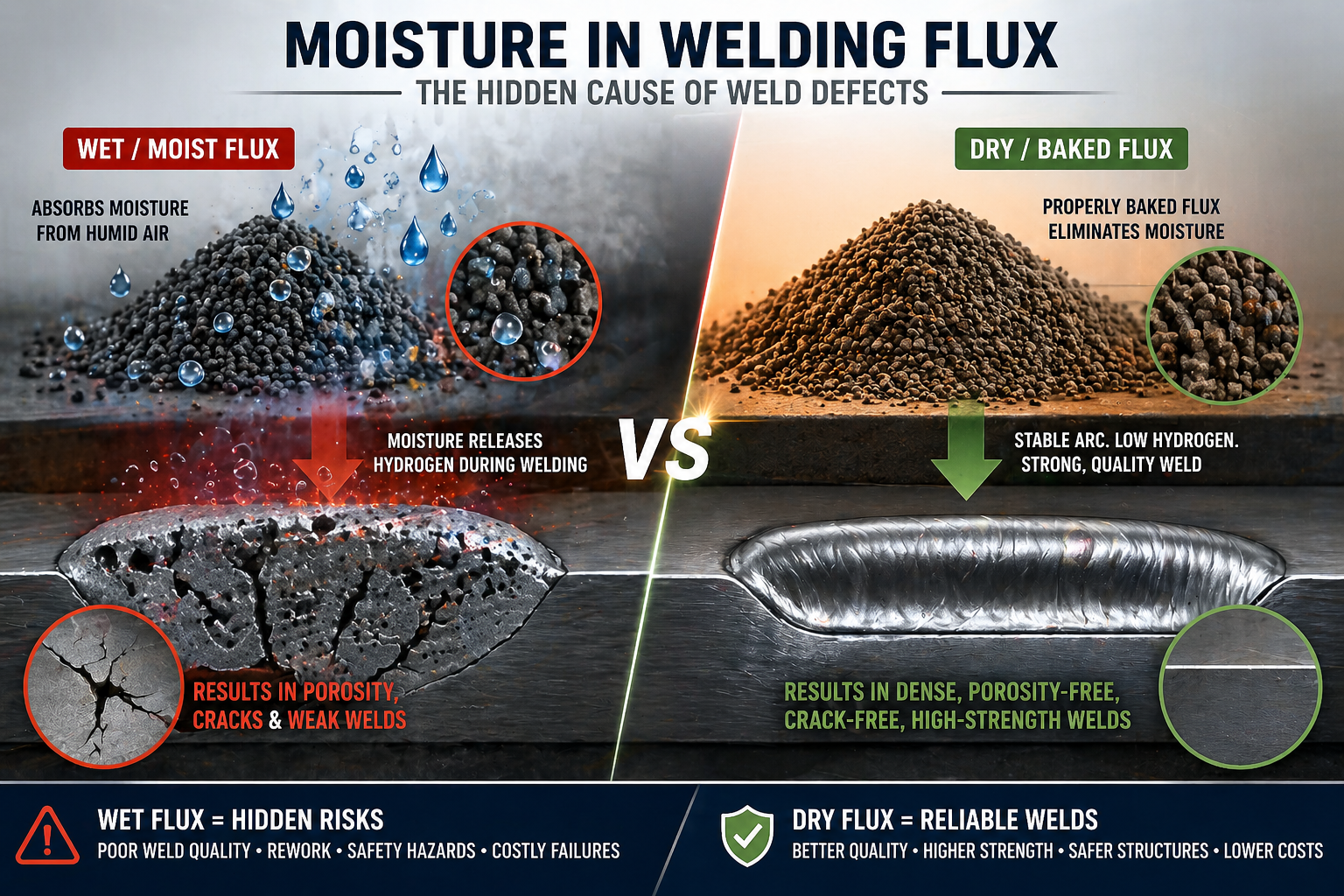
When flux absorbs moisture and is then used in welding, the hydrogen content in the weld zone increases significantly. This leads to a phenomenon known as Hydrogen-Induced Cracking (HIC) — also called cold cracking or delayed cracking — which can appear hours or even days after welding is complete. In structural applications like bridges, pressure vessels, offshore platforms, and pipelines, a crack that appears 48 hours after welding is arguably more dangerous than one caught during the process.
Here is what happens step by step when you use wet flux:
- Hydrogen atoms dissolve into the molten weld metal
- As the metal cools and solidifies, hydrogen gets trapped
- Residual stresses + trapped hydrogen = microcracks
- Microcracks propagate under load, sometimes causing catastrophic failure
- Visual inspection cannot catch HIC until it is too late
This is precisely why AWS (American Welding Society) standards and major industry codes mandate proper flux handling, including storage, drying, and rebaking procedures. A properly maintained flux baking oven manufacturer in Pune like REEW builds ovens that meet these exact standards.
How Does a Flux Baking Oven Work?
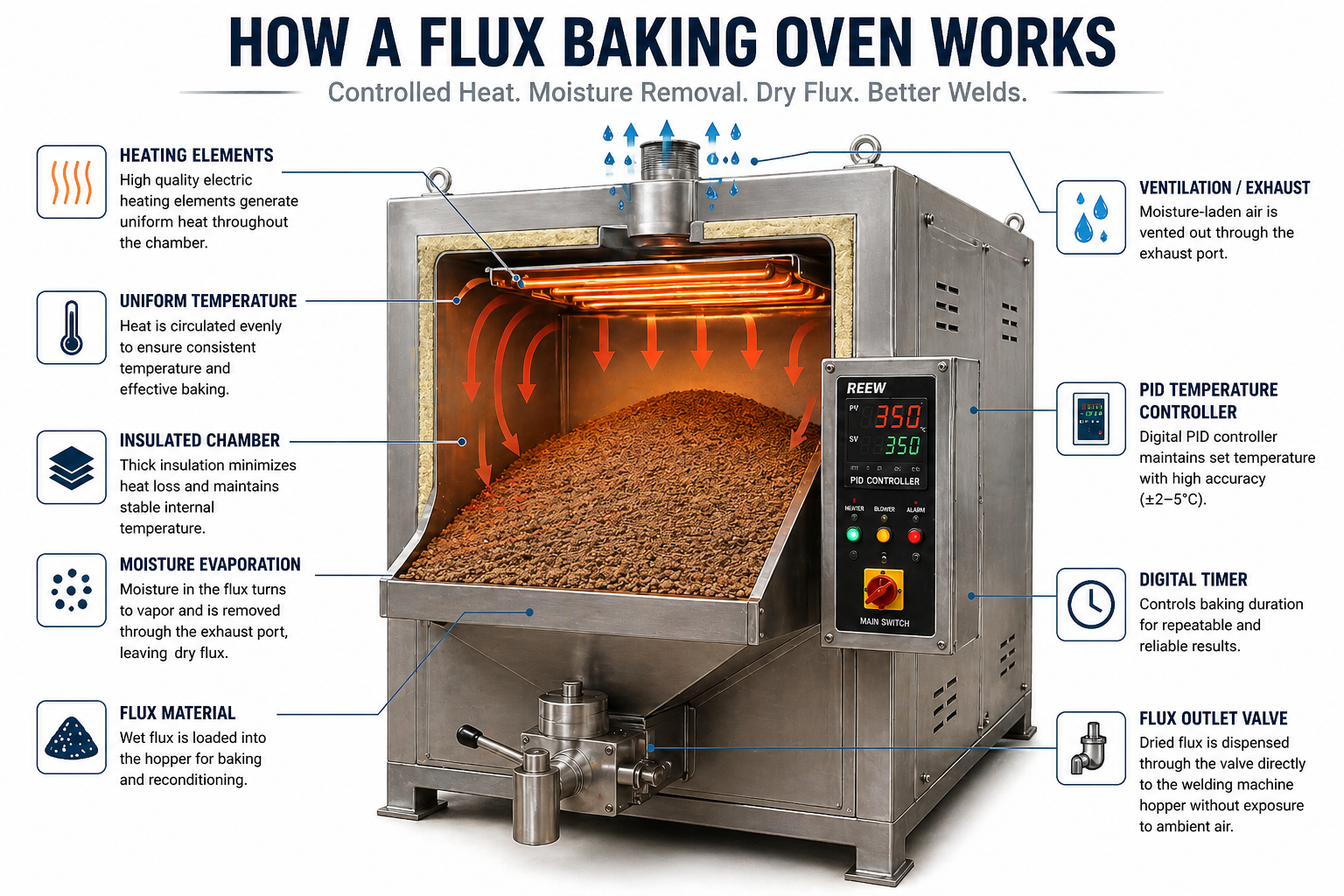
Understanding the working principle of a flux baking oven helps you operate it correctly and choose the right specifications for your application. The process is elegantly simple — but the engineering behind it is precise.
The Core Working Principle
A flux baking oven uses controlled, uniform heat — typically generated by electric heating elements — to raise the temperature inside the chamber to a range where moisture evaporates from the flux coating without damaging the flux chemistry. The moisture-laden air is then vented out through a ventilation system, leaving behind dry, ready-to-use flux.
Here is the process in sequence:
- Flux is loaded into the oven — either in hopper-style top-loading designs or through front-loading shelves
- The oven heats up to the set temperature (typically 150°C to 400°C depending on flux type)
- Temperature is held constant using a digital PID controller for a set duration (usually 1–4 hours)
- Moisture evaporates and exits through the controlled ventilation ports
- The oven maintains the temperature until flux is dispensed for use
Key Components of a Flux Baking Oven
| Component | Function / Importance |
| Heating Elements (Tubular/Mica) | Generate uniform heat throughout the chamber |
| PID Temperature Controller | Maintains precise set-point temperature ±2–5°C |
| Insulated Chamber (SS304) | Prevents heat loss; SS304 resists corrosion from moisture vapour |
| Ventilation / Exhaust Port | Removes moisture-laden air from the chamber |
| Digital Timer | Controls baking duration for repeatable cycles |
| Safety Thermostat (Overtemp) | Cuts power if temperature exceeds safe threshold |
| Flux Outlet Valve (Hopper type) | Dispenses dried flux directly without re-exposure to air |
| Pro Note: In REEW flux baking ovens, we ensure that electrical heating elements NEVER make direct contact with the flux material. This eliminates contamination risk and extends both heater and flux life. Always confirm this design feature when evaluating any flux oven manufacturer in India. |
Types of Flux Baking Ovens Available in India
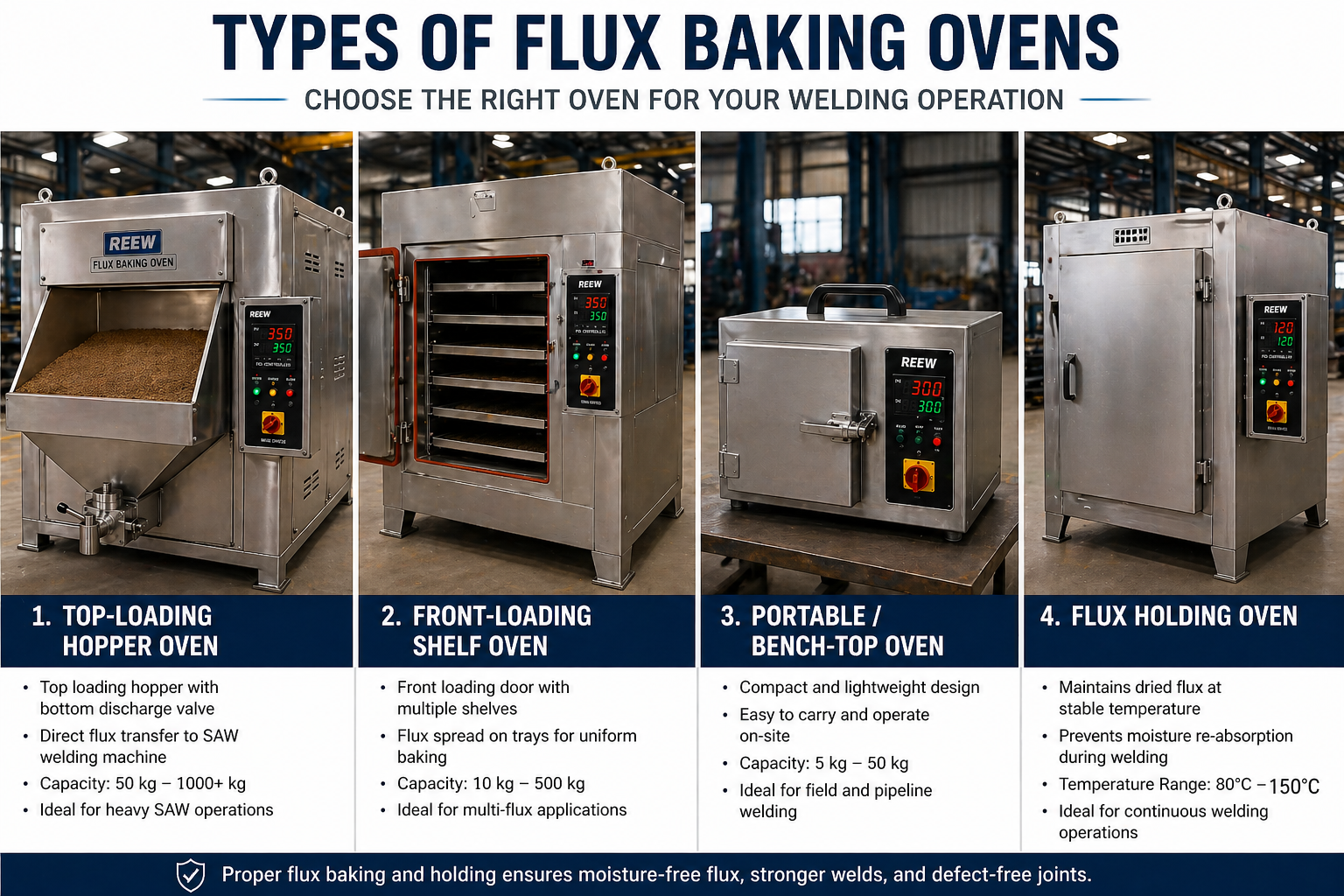
Not all flux baking ovens are the same — and choosing the wrong type for your application is one of the most common and costly mistakes I see fabrication units make. Let me walk you through the main types and where each one belongs.
1. Top-Loading (Hopper-Style) Flux Baking Oven
This is the most widely used type in heavy submerged arc welding operations. Flux is loaded from the top into a hopper-shaped SS304 chamber, and dispensed from a valve at the bottom directly into the flux hopper of the welding machine — with zero exposure to ambient air in between. This is the gold standard for large-scale SAW operations.
- Capacity: 50 kg to 1000 kg+
- Temperature range: Ambient to 400°C
- Best for: Shipyards, pipeline welding, heavy fabrication
- REEW offers: Standard and pneumatic auto-door versions
2. Front-Loading (Shelf-Type) Flux Baking Oven
Similar in design to a conventional industrial oven but optimised for flux drying. Flux is spread on SS trays and slid into the chamber on shelf runners. Excellent for lower volumes or when multiple flux types need to be dried simultaneously on separate shelves.
- Capacity: 10 kg to 500 kg
- Temperature range: Up to 400°C
- Best for: Fabrication workshops, multi-flux operations
- Advantage: Can also double as an electrode baking oven
3. Portable / Bench-Top Flux Oven
Compact, lightweight units designed for site use. If your welding team moves between job sites — as is common in pipeline and construction welding — a portable flux oven ensures that flux is always in optimal condition at the point of use. These units typically handle 5–50 kg of flux.
- Best for: On-site construction, pipeline welding projects
- Power: Standard 230V single-phase supply
- Weight: Usually under 30 kg for easy transport
4. Industrial Flux Holding Oven
Technically distinct from a baking oven — a holding oven keeps already-dried flux at a lower temperature (typically 80–150°C) to prevent moisture re-absorption during a welding shift. Many serious welding operations use both: a high-temperature baking oven for reconditioning and a holding oven at the workstation for ready access.
- Temperature range: 80°C to 150°C
- Purpose: Maintain dryness after baking
- Best for: Continuous 12–24 hour welding shifts
| Oven Type | Capacity Range | Temp Range | Loading Style | Best Application |
| Top-Loading Hopper | 50–1000 kg | Up to 400°C | Top / Bottom valve | SAW heavy fabrication |
| Front-Loading Shelf | 10–500 kg | Up to 400°C | Front door / Trays | Multi-flux workshops |
| Portable Bench-Top | 5–50 kg | Up to 300°C | Front door | On-site / pipeline |
| Flux Holding Oven | 10–200 kg | 80–150°C | Front door | Workstation holding |
| Need a Flux Baking Oven for Your Welding Operation?
REEW (Rajesh Electricals & Engineering Works) has been manufacturing precision industrial ovens from Pune, India since 1980. We build custom flux baking ovens, electrode ovens, and flux drying ovens for welding operations across India. Call: 08046077822 | ✉ Email: sales@rajeshele.com | Visit: reew.in |
Which Industries Need a Flux Baking Oven?
In my experience supplying industrial ovens across India for over four decades, the demand for flux baking ovens is concentrated in industries where weld quality is not just a performance parameter — it is a safety and compliance requirement. Here are the key sectors:
Shipbuilding and Offshore Fabrication
Ships and offshore structures operate in the most hostile corrosive environments on earth. A single weld failure below the waterline can be catastrophic. Shipyards in cities like Mumbai, Vizag, and Kolkata routinely use large-capacity top-loading flux baking ovens running at 300–400°C for SAW flux reconditioning before every shift.
Pipeline Welding (Oil, Gas, and Water)
Pipeline welding is governed by codes such as API 1104 and ASME B31.3, all of which have specific provisions for electrode and flux handling. Hydrogen cracking in a buried pipeline is enormously expensive to repair and potentially dangerous. Portable flux baking ovens and electrode holding ovens are standard equipment on every responsible pipeline project.
Pressure Vessel and Boiler Manufacturing
ASME Section VIII for pressure vessels demands the highest weld quality standards. Any hydrogen-induced defect in a pressure vessel weld is an automatic rejection during radiographic or ultrasonic testing — and a costly rework. Flux baking ovens are non-negotiable here.
Structural Steel Fabrication and Construction
Bridges, industrial structures, stadium roofs, high-rises — structural steel fabricators across Maharashtra and Pune increasingly understand that the few lakhs invested in a good flux baking oven saves crores in rework, delays, and liability.
Automotive and Railway Component Manufacturing
Pune’s booming automotive manufacturing hub — home to Tata Motors, Bajaj, Mercedes-Benz, and hundreds of tier-1 suppliers — relies on high-integrity welded components. Flux baking ovens ensure consistent weld quality across high-volume production lines.
How to Choose the Right Flux Baking Oven: 8 Factors to Consider
This is the section I find myself having the most conversations about with customers. Choosing a flux baking oven is not just about picking the cheapest option that fits your floor space. Here are the 8 factors I walk every customer through:
1. Capacity (kg) — Match It to Your Shift Consumption
The most common mistake is under-sizing. Calculate your average flux consumption per welding shift and size the oven to hold at least 1.5x that amount. Running the oven continuously to replenish small batches is inefficient and hard on the heating elements. Most serious SAW operations need at least 200–500 kg capacity.
2. Maximum Temperature Range
Different flux types require different rebaking temperatures. Basic fluxes typically require 300–400°C; some special-purpose fluxes may require only 150–200°C. Always check your flux manufacturer’s datasheet. Choose an oven with at least 20–30°C headroom above your maximum required temperature.
3. Temperature Uniformity (±°C)
A flux baking oven that shows 350°C on the display but has 50°C cold spots in the corners is useless. Uniform heat distribution — typically ±5–10°C — is critical. Ask any flux oven manufacturer in Pune for their documented temperature uniformity data before purchasing.
4. Chamber Construction Material
The interior chamber should be constructed from SS304 or SS316 stainless steel. Moisture and flux can be corrosive to mild steel liners, leading to contamination of your flux and premature oven failure. REEW uses SS304 chambers as standard across all flux baking oven models.
5. Loading and Dispensing Design
For SAW operations, a hopper-style top-loading oven with a bottom dispensing valve eliminates the need to handle flux in open air between drying and use. This dramatically reduces moisture re-absorption risk. For electrode baking applications, tray-style front-loading designs work well.
6. Controller Type and Data Logging
A PID digital controller with a digital display is the minimum acceptable standard today. For operations that need to document process compliance (aerospace, pressure vessels, nuclear), look for ovens with programmable ramp-and-soak profiles and data logging output. REEW can supply ovens with digital data logging as an option.
7. Safety Features
Do not overlook safety. Essential features include: over-temperature cutout, door interlock switches, earthing/grounding provisions, and thermal insulation on external surfaces to prevent operator burns. Any reputable industrial oven supplier in Pune should provide these as standard.
8. After-Sales Service and Spare Parts Availability
A flux baking oven that breaks down in the middle of a project can shut down your entire welding operation. Choose a manufacturer with a local service team, quick spare parts availability, and a genuine commitment to after-sales support. REEW has been servicing ovens across Maharashtra since 1980 — we understand what continuity of operations means to our customers.
Flux Baking Temperature Guide: Quick Reference by Flux Type
One of the most frequently searched questions I see from welding engineers is: ‘What temperature should I bake my welding flux at?’ Here is a practical reference table based on industry standards and manufacturer data:
| Flux / Electrode Type | Drying Temp (°C) | Duration (Hours) | Notes |
| SAW Flux (Basic/Agglomerated) | 300–400°C | 1–2 hrs | Standard rebaking cycle |
| SAW Flux (Fused) | 150–250°C | 1–2 hrs | Lower temp needed; fused is less hygroscopic |
| Low-Hydrogen SMAW Electrodes | 300–350°C | 1–2 hrs | AWS A5.1 requirement |
| Basic MIG/MAG Flux-Cored Wire | 100–200°C | 1 hr | Check wire manufacturer data |
| Special Alloy / Stainless Flux | 200–300°C | 2 hrs | Follow filler metal cert sheet |
| Flux after prolonged open exposure | 400°C | 2–4 hrs | Aggressive rebake for fully wet flux |
| Important: Always refer to your specific flux manufacturer’s technical datasheet for exact rebaking parameters. The table above is a general industry reference only. Using too high a temperature or too long a duration can degrade flux chemistry — always err on the side of the manufacturer’s recommended parameters. |
7 Common Mistakes Welding Shops Make with Flux Handling (And How to Avoid Them)
I have visited hundreds of fabrication shops across India. Here are the mistakes I see repeatedly — and what they cost:
| Mistake | Why It Hurts / What to Do Instead |
| Storing flux bags on the factory floor | Floor-level moisture absorption is rapid. Store sealed in a dry room above 15°C, on pallets. |
| Reusing flux without rebaking after exposure | Even a few hours of air exposure in humid conditions (like during monsoon in Pune) requires rebaking. |
| Using a single oven for baking AND holding | Baking requires high temp cycles; holding needs stable lower temp. Use separate ovens for best results. |
| Skipping temperature calibration checks | Oven controllers drift over time. Calibrate with a reference thermocouple every 6 months. |
| Overloading the oven | Too much flux per load = poor heat penetration. Follow the rated capacity and allow airflow. |
| No data logging for certified work | For ASME/API work, you need documented proof of flux conditioning. Use a logging controller. |
| Buying cheap ovens with no after-sales support | Breakdown = downtime. A ₹50,000 saving on the oven can cost ₹5 lakh in lost production. |
Why REEW Is a Trusted Flux Baking Oven Manufacturer in Pune
I am obviously not a neutral party here — but I will let our track record speak. REEW (Rajesh Electricals and Engineering Works) has been designing, manufacturing, and commissioning industrial heating solutions from Pune since 1980. That is over 45 years of accumulated knowledge in industrial oven engineering.
What sets our flux baking ovens apart:
- SS304 inner chamber as standard — no compromise on construction quality
- No direct contact between heating elements and flux material
- PID digital temperature controllers with ±2°C accuracy
- Uniform heat distribution verified at factory before dispatch
- Custom capacity options from 25 kg to 2000 kg+
- CE/BIS-compliant electrical construction with certified heater elements
- Over 35 top-tier clients across automotive, aerospace, and heavy engineering
- Factory-tested and pre-commissioned before delivery — not assembled at site
Every oven we build goes through a complete factory commissioning run before it leaves our workshop. We do not ship an untested unit. If you are looking for an industrial oven supplier in India that you can genuinely trust — not just the lowest bidder on IndiaMart — come visit us in Pune.
| Need a Flux Baking Oven for Your Welding Operation?
REEW (Rajesh Electricals & Engineering Works) has been manufacturing precision industrial ovens from Pune, India since 1980. We build custom flux baking ovens, electrode ovens, and flux drying ovens for welding operations across India. Call: 08046077822 | ✉ Email: sales@rajeshele.com | Visit: reew.in |
Explore More from Our Knowledge Base
If this guide has been useful to you, these related articles from our blog will take your understanding of electrode and flux handling even further:
→ Electrode Oven vs Electrode Drying Oven vs Electrode Holding Oven — What Is the Difference?
→ REEW Industrial Ovens & Heating Solutions — Product Overview
→ REEW Company Profile — Industrial Oven Manufacturer Since 1980
Official Standards and Reference Resources
For welding engineers and procurement professionals who want to verify compliance requirements for flux handling:
→ AWS (American Welding Society) — Electrode and Flux Storage Standards: https://www.aws.org
→ ASME Boiler and Pressure Vessel Code (Section IX — Welding): https://www.asme.org/codes-standards/find-codes-standards/bpvc-ix-boiler-pressure-vessel-code-section-ix
→ Bureau of Indian Standards (BIS) — Welding Consumables: https://www.bis.gov.in
Frequently Asked Questions (FAQs) About Flux Baking Ovens
Q1. What is the difference between a flux baking oven and a flux drying oven?
The terms are often used interchangeably in the industry. Strictly speaking, a flux drying oven refers to the process of removing surface moisture at lower temperatures (100–200°C), while a flux baking oven (or rebaking oven) operates at higher temperatures (300–400°C) to remove deeply absorbed hydrogen. In most industrial contexts, the same oven performs both functions.
Q2. What temperature should a flux baking oven operate at?
For standard SAW flux, the recommended rebaking temperature is 300–400°C for 1–2 hours. Low-hydrogen SMAW electrodes are typically reconditioned at 300–350°C. Always refer to the specific flux or electrode manufacturer’s technical datasheet, as overheating can degrade flux chemistry and affect weld quality.
Q3. How long does it take to bake welding flux?
A typical rebaking cycle takes 1–4 hours depending on the flux type, the level of moisture exposure, and the oven capacity. For flux that has been exposed to open air during a monsoon or humid environment, a longer cycle of 2–4 hours at maximum recommended temperature is advisable. REEW ovens with forced-air circulation systems can reduce cycle times significantly.
Q4. Can the same oven be used for flux baking and electrode baking?
Yes, in most cases. A good quality industrial flux baking oven with tray or shelf capability can also be used for electrode reconditioning. The key requirement is temperature range — make sure the oven can reach the required temperature for both flux (up to 400°C) and electrodes (up to 450°C for some types). REEW’s front-loading shelf ovens are routinely used for both applications.
Q5. How much does a flux baking oven cost in India?
Pricing varies widely based on capacity, construction quality, and features. A basic 50 kg bench-top unit starts from approximately ₹30,000–₹50,000, while a full-capacity 500 kg industrial flux baking oven with digital controls and SS304 construction typically ranges from ₹2,00,000 to ₹6,00,000+. Custom-built units for large SAW operations can go higher. Contact REEW for a detailed quotation based on your exact requirements.
Q6. Where can I buy a flux baking oven in Pune?
REEW (Rajesh Electricals and Engineering Works) is a leading flux baking oven manufacturer in Pune and flux baking oven supplier in Maharashtra. With over 45 years of manufacturing experience and a dedicated service team, we supply directly to fabrication units, shipyards, and automotive manufacturers across India. Call us at 08046077822 or visit reew.in.
Q7. What is the lifespan of a flux baking oven?
A well-built industrial flux baking oven from a reputable manufacturer should last 15–25 years with regular maintenance. The most commonly replaced components are heating elements (every 3–7 years depending on usage cycles), door gaskets, and temperature controllers. REEW ovens are built with replaceable heating element designs so you never have to replace the entire oven.
Q8. Do I need separate flux baking and flux holding ovens?
For serious continuous welding operations — especially in shipbuilding, pipeline, and pressure vessel work — yes, ideally you should have both. A high-temperature baking/rebaking oven for reconditioning flux and a separate lower-temperature holding oven at the welding workstation. This ensures flux is always available in a dry condition without having to run repeated high-temperature cycles throughout the day.
Q9. What are the signs that my welding flux has absorbed moisture?
Common signs of moisture contamination in flux include: increased porosity in welds, rough or irregular weld bead surface, excessive spatter during welding, difficulty in slag removal, and in severe cases, visible hydrogen cracking or fisheye fractures on broken weld specimens. If you observe any of these, rebake your flux immediately before continuing.
Q10. Is a flux baking oven required by welding codes?
Yes, for many critical applications. AWS D1.1 (Structural Welding Code), ASME Section IX, and API 1104 all contain provisions for flux and electrode storage and conditioning that effectively mandate the use of drying/baking equipment. For projects governed by these codes, proper documentation of flux conditioning cycles may also be required as part of quality records.
Final Thoughts — Invest in the Right Flux Baking Oven Before It Costs You
If there is one message I want to leave you with, it is this: the quality of your welds is only as good as the quality of your consumables — and flux that has absorbed moisture is already compromised before it touches the arc.
A flux baking oven is not a luxury. For any fabrication unit doing structural, pipeline, pressure vessel, or shipbuilding work, it is as fundamental as the welding machine itself. The cost of a quality oven from a trusted manufacturer is a fraction of what you will spend on rework, NDT re-testing, and project delays caused by hydrogen-induced cracking.
At REEW, we have built our reputation over 45+ years by manufacturing ovens that genuinely perform — not just on paper, but in the most demanding real-world welding environments across India. Every oven we ship is factory-commissioned, tested, and backed by a team that understands your process.
If you are ready to get the right flux baking oven for your operation, we would love to talk. No generic quotations — a real conversation about your specific requirements.
| Need a Flux Baking Oven for Your Welding Operation?
REEW (Rajesh Electricals & Engineering Works) has been manufacturing precision industrial ovens from Pune, India since 1980. We build custom flux baking ovens, electrode ovens, and flux drying ovens for welding operations across India. Call: 08046077822 | ✉ Email: sales@rajeshele.com | Visit: reew.in |
Comments (2)
Tubular Heater Manufacturers in India | REEW Pune
says July 17, 2026 at 6:57 am[…] -> Flux Baking Oven: Complete Guide — How They Work, Types, and How to Choose One […]
Flux Baking Oven: Working Principle, Temperature & Applications
says September 10, 2026 at 12:15 pm[…] -> Flux Baking Oven: Complete Guide Types, Temperatures, and How to Choose […]